Stagnation Pressure Measurement: The stagnation pressure is an indication of entropy level in a flowing fluid and the change in entropy is associated to the irreversibility. When the flow from a reservoir takes place isentrpoically, the static pressure record of the fluid in the reservoir indicates the stagnation pressure of the fluid. This situation of measuring pressure is analogous when the flowing stream is brought to rest isentropically. However, due to many irreversibility associated to the flow such as shock wave and frictional effects, the stagnation pressure may not be equal to the reservoir pressure. So, this pressure is always measured locally in the flow field. In order to measure the stagnation pressure at any local section, a stagnation probe is placed in the stream parallel to the flow with its open end facing the flow as shown in Fig. 7.6.3. Thus, it allows the fluid to get decelerated isentropically to rest through the passage. The reading in the probe gives the stagnation pressure at the location where the nose of the probe is oriented. This device was first used by Henery Pitot for measurement of pressure and hence named as Pitot tube. At low Reynolds number flow, the deceleration may not be isentropic and inaccuracy in the measurements can arise.
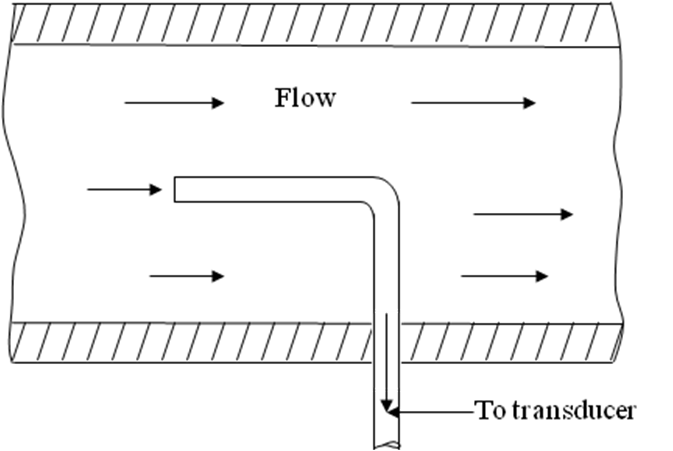
Fig. 7.6.3: Pitot tube for stagnation pressure measurement.
Measurements of Flow Velocity
In most of the cases, the flow velocity is obtained through simultaneous measurement of static and stagnation pressures using a Prandtl Pitot Static probe (Fig. 7.6.4). It has opening at the nose for stagnation pressure communications while several number of equal size holes are made around the circumference of the probe at the location downstream of the nose. The difference pressure gives the dynamic pressure. Further, Bernoulli equation can be applied to calculate the flow velocity.
 |
(7.6.1) |
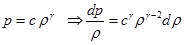
Now, replace the integral of Eq. (7.6.1) with the isentropic relation for gases;
 |
(7.6.2) |
where,  are the pressure, density and velocity, respectively, z is the elevation difference,
  is the specific heat ratio and C is a constant. Combine Eq. (7.6.1 & 7.6.2) and simplify to obtain the Bernoulli equation for one-dimensional frictionless isentropic flow for compressible fluid.
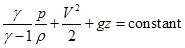 |
(7.6.3) |
Apply Eq. (7.6.3) along a stream line at the location of stagnation point and any desired location to obtain the flow velocity.
 |
(7.6.4) |