Measurement of Pressure
Many pressure measuring devices used for incompressible flows can be equally applicable for compressible flows if they are feasible for measurements in gases. They may be grouped into manometers and pressure transducers depending on the ranges of pressure and degree of precision. U-type liquid manometer, dial-type pressure gauge (Bourdon tube), electrical/mechanical/optical types of pressure transducers are few popular pressure measuring devices.
With respect to compressible flow field, the measurement concept of both static and stagnation pressure (Fig. 7.6.1) are equally important. Both the pressures along with the temperature can be used for calculating local flow velocity, Mach number and density of the flowing stream. When the measurement is made in such a way that the velocity of the flow is not disturbed, then the measured pressure indicates the static pressure . On the other hand, if the flow is brought to rest isentropically, then the pressure obtained, becomes the stagnation pressure.
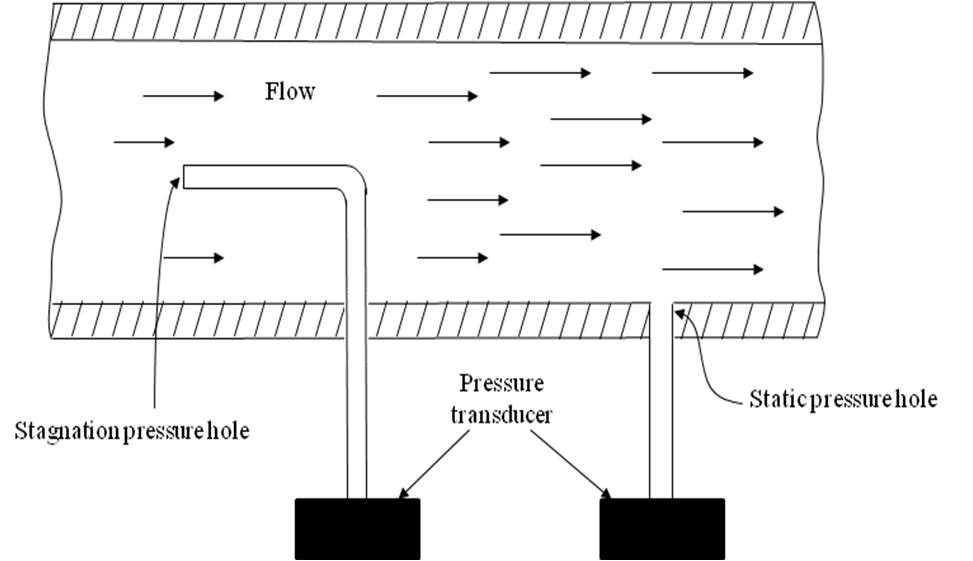
Fig. 7.6.1: Measurement concepts of static and stagnation pressures.
Static Pressure Measurement : The wall static pressure measurement is important in situations like inner walls of duct flows, surface of an airfoil etc. Here, a small hole is drilled normal to the surface (commonly called as pressure tapping) so that pressure measuring device can be connected (Fig. 7.6.2-a). In order to measure the static pressure at any interior point in the flow, a probe may be inserted without disturbing the flow streamlines (Fig. 7.6.2-b). The static pressure of the fluid stream over the surface is transmitted through orifice in the plane of the flow and subsequently recorded by the pressure measuring instrument. While measuring pressures through probe, the position of sensing holes and the support stem is very important. The deviation of actual and measured pressure may arise due to nose effect and stem effect. Since, both the effects have opposite nature; it may be possible to cancel these effects by suitable design.
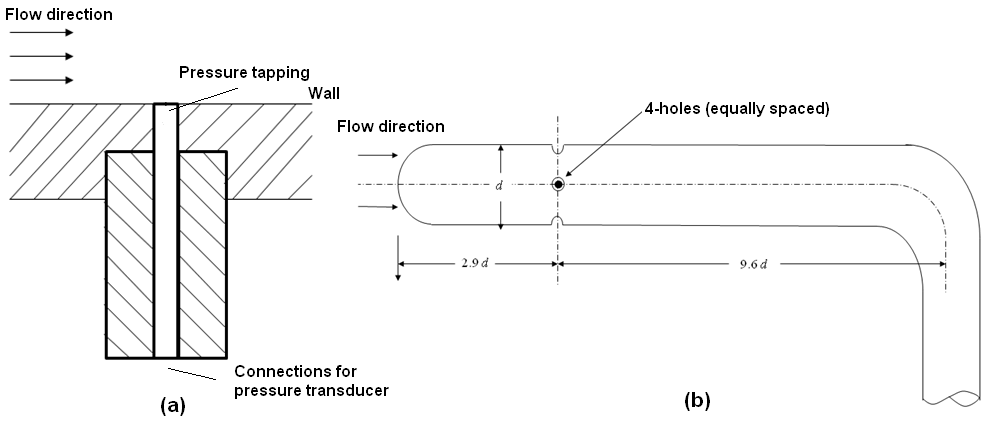
Fig. 7.6.2: Static pressure measurements in compressible flows: (a) wall pressure tapping; (b) static pressure probe.