1. What do you mean by viscous flow?
2. What is Hagen-Poi sullies formula? Derive an expression for Hagen-Poi sullies formula.
3. Prove that the velocity distribution is parabolic in nature, when the viscous flow passes through two fixed plates.
4. Define viscous dissipation.
5. Derive the expressions for velocity and shear distribution (Couette Flow) for the viscous fluid passes through two parallel plates separated by a distance D and the upper plate is moving to right at velocity U.
6. Show that the value of co-efficient of friction for the viscous flow through the circular pipe is given by 
7. Prove that the pressure gradient in a direction of motion is equal to the shear gradient normal to the direction of motion in a steady laminar flow.
8. What is boundary layer? What causes a boundary layer to develop?
9. What are boundary-layer approximations?
10. List out the methods for preventing the separation boundary layer.
11. Explain the effect of pressure gradient on boundary layer separation
12. Define the terms
a) Laminar boundary layer b) Turbulent boundary layer c) Laminar sub-layer
13. What is a boundary layer and explain how it develops for a flat plate.
14. What is No-slip condition?
15. Explain the difference between a favorable and adverse pressure gradient in a boundary layer. In which case, does the pressure increase downstream? Why?
16. Discuss the implication of an inflection point in a boundary layer profile. Specifically, does the existence of an inflection point infer a favorable or adverse pressure gradient? Explain
17. Differentiate between velocity boundary layer thickness and thermal boundary layer thickness?
18. How does Prandtl number related to viscous and thermal boundary layer?
19. State and derive the following boundary layer properties
a) Displacement thickness b) momentum thickness c) Energy thickness
20. Derive boundary layer equations from the complete Navier- Stroke equations
21. Define creeping flow? Give two examples for this flow
22. Which are the applications of creeping flow theory?
SOLVED PROBLEMS
PROBLEM 1: A flat roof of a building is constructed of precast concrete slabs of width W = 1.5 m and depth L = 0.2 m, as shown in the figure. Through an oversight, an end joint between two slabs was not sealed, leaving a crack of width h = 1.0 mm. When it rains, the crack fills with water which leaks into the interior of the building. Calculate the volume flow rate of rain water through the crack assuming steady laminar flow (plane poiseuille) flow with 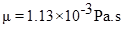
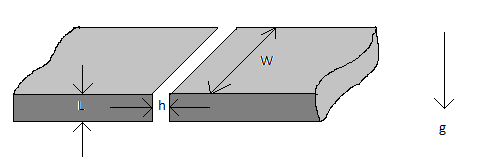
SOLUTION:
The volumetric flow rate through the crack is:
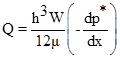
Measuring 'x' vertically downward from the upper surface,  is :
is :

And, assuming atmospheric pressure above and below the roof,
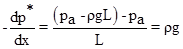
Consequently, the volume flow rate Q is:


