where,  is the entrance effect in terms of pressure drop, μ is the fluid viscosity, Q is the volume flow,
  are the length and radius of the pipe, respectively. It is seen from Fig. (5.5.1) that the pressure drop varies linearly with velocity up to the value 0.33m/s and a sharp change in pressure drop is observed after the velocity is increased above 0.6m/s. During the velocity range of 0.33 to 0.6m/s, the flow is treated to be under transition stage. When such a transition takes place, it is normally initiated through turbulent spots/bursts that slowly disappear as shown in Fig. 5.5.2. In the case of pipe flow, the flow Reynolds number based on pipe diameter is above 2100 for which the transition is noticed. The flow becomes entirely turbulent if the Reynolds number exceeds 4000.
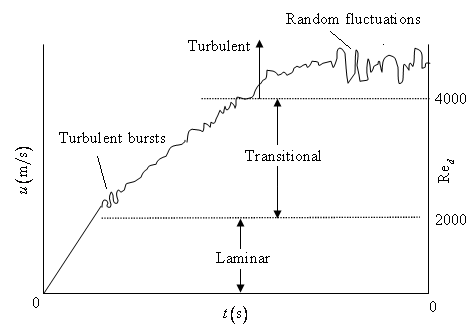
Fig. 5.5.2: Schematic representation of laminar to turbulent transition in a pipe flow.
Turbulent Flow Solutions
In the case of turbulent flow, one needs to rely on the empirical relations for velocity profile obtained from logarithmic law . If  is the local mean velocity across the pipe of radius R and
  is the friction velocity , then the following empirical relation holds good;
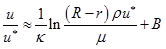 |
(5.5.2) |