Inviscid Hypersonic Flow over a Flat Plate
Consider a two-dimensional flat plate of certain length  , inclined at angle
  with respect to free stream hypersonic flow (Fig. 4.8.2). Now, the Newtonian theory can be applied at the lower and upper surface of the plate to obtain the pressure coefficient
  .
.
 |
(4.8.3) |
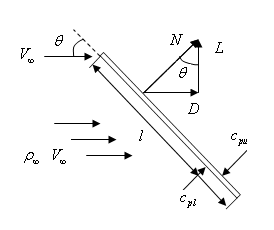
Fig. 4.8.2: Illustration of aerodynamic forces for a flat plate in hypersonic flow.
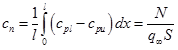
The difference in pressures in the upper and lower surface of the plate, gives rise to a normal force  . The normal force coefficient
  can also be readily defined through the following formula.
 |
(4.8.4) |
Here, 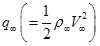 is the free stream dynamic pressure,
  is the frontal area per unit width and
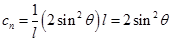
  is the distance along the length of the plate from the leading edge. Now, substitute Eq. (4.8.3) in Eq. (4.8.4) to obtain the simplified relations;
 |
(4.8.5) |
If L and D are defined as the lift and drag as shown in Fig. 4.8.2, then the other aerodynamic parameters such as lift coefficient  and drag coefficient
  can be expressed in the following fashion.
 |
(4.8.6) |
Referring to geometry of Fig. 4.8.2, the other important parameter lift-to-drag is obtained through the following relation;
 |
(4.8.7) |