Supersonic flow : In a flow field, if the Mach number is more than 1 everywhere in the domain, then it defined as supersonic flow. In order to minimize the drag, all aerodynamic bodies in a supersonic flow, are generally considered to be sharp edged tip. Here, the flow field is characterized by straight, oblique shock as shown in Fig. 4.2.2(d). The stream lines ahead of the shock the streamlines are straight, parallel and horizontal. Behind the oblique shock, the streamlines remain straight and parallel but take the direction of wedge surface. The flow is supersonic both upstream and downstream of the oblique shock. However, in some exceptional strong oblique shocks, the flow in the downstream may be subsonic.
Hypersonic flow : When the free stream Mach number is increased to higher supersonic speeds, the oblique shock moves closer to the body surface (Fig. 4.2.2-e). At the same time, the pressure, temperature and density across the shock increase explosively. So, the flow field between the shock and body becomes hot enough to ionize the gas. These effects of thin shock layer, hot and chemically reacting gases and many other complicated flow features are the characteristics of hypersonic flow. In reality, these special characteristics associated with hypersonic flows appear gradually as the free stream Mach numbers is increased beyond 5.
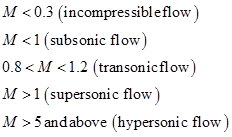
As a rule of thumb, the compressible flow regimes are classified as below;
Rarefied and Free Molecular Flow : In general, a gas is composed of large number of discrete atoms and molecules and all move in a random fashion with frequent collisions. However, all the fundamental equations are based on overall macroscopic behavior where the continuum assumption is valid. If the mean distance between atoms/molecules between the collisions is large enough to be comparable in same order of magnitude as that of characteristics dimension of the flow, then it is said to be low density/rarefied flow. Under extreme situations, the mean free path is much larger than the characteristic dimension of the flow. Such flows are defined as free molecular flows. These are the special cases occurring in flight at very high altitudes (beyond 100 km) and some laboratory devices such as electron beams.