Wave Propagation in a Compressible Media
Consider a gas confined in a long tube with piston as shown in Fig. 4.2.1(a). The gas may be assumed to have infinite number of layers and initially, the system is in equilibrium. In other words, the last layer does not feel the presence of piston. Now, the piston is given a very small ‘push' to the right. So, the layer of gas adjacent to the piston piles up and is compressed while the reminder of the gas remains unaffected. With due course of time, the compression wave moves downstream and the information is propagated. Eventually, all the gas layers feel the piston movement. If the pressure pulse applied to the gas is small, the wave is called as sound wave and the resultant compression wave moves at the “speed of sound”. However, if the fluid is treated as incompressible, the change in density is not allowed. So, there will be no piling of fluid due to instantaneous change and the disturbance is felt at all other locations at the same time. So, the speed of sound depends on the fluid property i.e. ‘compressibility'. The lower is its value; more will be the speed of sound. In an ideal incompressible medium of fluid, the speed of sound is infinite. For instance, sound travels about 4.3-times faster in water (1484 m/s) and 15-times as fast in iron (5120 m/s) than air at 20ºC.
Let us analyze the piston dynamics as shown in Fig. 4.2.1(a). If the piston moves at steady velocity  , the compression wave moves at speed of sound
  into the stationary gas. This infinitesimal disturbance creates increase in pressure and density next to the piston and in front of the wave. The same effect can be observed by keeping the wave stationary through dynamic transformation as shown in Fig. 4.2.1 (b). Now all basic one dimensional compressible flow equations can be applied for a very small control enclosing the stationary wave.
Continuity equation : Mass flow rate  is conserved across the stationary wave.
 |
(4.2.1) |
Momentum equation : As long as the compression wave is thin, the shear forces on the control volume are negligibly small compared to the pressure force. The momentum balance across the control volume leads to the following equation;
 |
(4.2.2) |
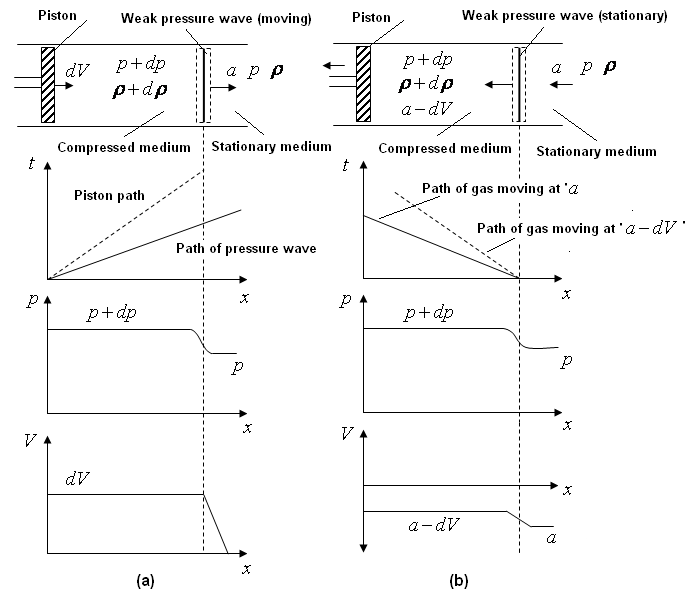
Fig. 4.2.1: Propagation of pressure wave in a compressible medium: (a) Moving wave; (b) Stationary wave.