Compressible Flow Regimes
In order to illustrate the flow regimes in a compressible medium, let us consider the flow over an aerodynamic body (Fig. 4.2.2). The flow is uniform far away from the body with free stream velocity  while the speed of sound in the uniform stream is
  . Then, the free stream Mach number becomes
  . The streamlines can be drawn as the flow passes over the body and the local Mach number can also vary along the streamlines. Let us consider the following distinct flow regimes commonly dealt with in compressible medium.
Subsonic flow : It is a case in which an airfoil is placed in a free stream flow and the local Mach number is less than unity everywhere in the flow field (Fig. 4.2.2-a). The flow is characterized by smooth streamlines with continuous varying properties. Initially, the streamlines are straight in the free stream, but begin to deflect as they approach the body. The flow expands as it passed over the airfoil and the local Mach number on the top surface of the body is more than the free stream value. Moreover, the local Mach number (M) in the surface of the airfoil remains always less than 1, when the free stream Mach number  is sufficiently less than 1. This regime is defined as subsonic flow which falls in the range of free stream Mach number less than 0.8 i.e.
  .
.
Transonic flow : If the free stream Mach number increases but remains in the subsonic range close to 1, then the flow expansion over the air foil leads to supersonic region locally on its surface. Thus, the entire regions on the surface are considered as mixed flow in which the local Mach number is either less or more than 1 and thus called as sonic pockets (Fig. 4.2.2-b). The phenomena of sonic pocket is initiated as soon as the local Mach number reaches 1 and subsequently terminates in the downstream with a shock wave across which there is discontinuous and sudden change in flow properties. If the free stream Mach number is slightly above unity (Fig. 4.2.2-c), the shock pattern will move towards the trailing edge and a second shock wave appears in the leading edge which is called as bow shock . In front of this bow shock, the streamlines are straight and parallel with a uniform supersonic free stream Mach number. After passing through the bow shock, the flow becomes subsonic close to the free stream value. Eventually, it further expands over the airfoil surface to supersonic values and finally terminates with trailing edge shock in the downstream. The mixed flow patterns sketched in Figs. 4.2.2 (b & c), is defined as the transonic regime .
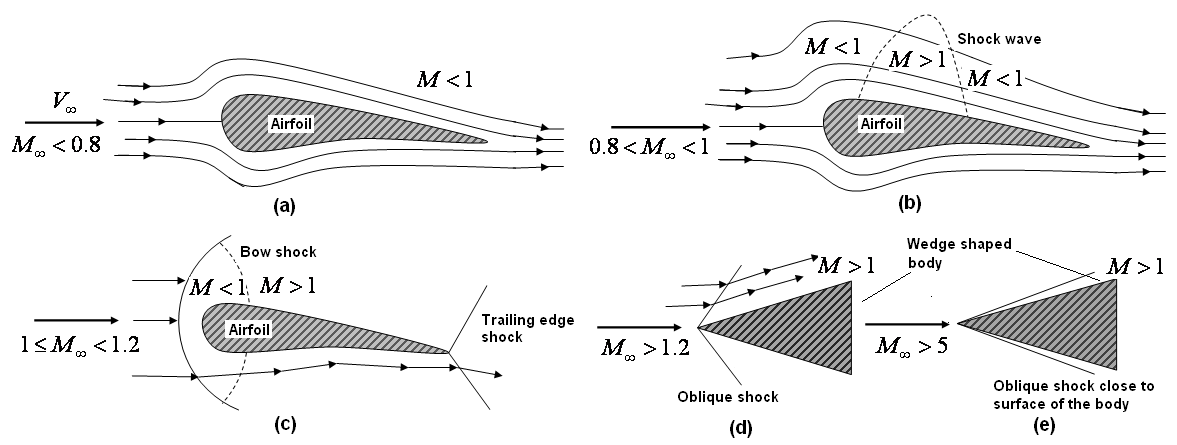
Fig. 4.2.2: Illustration of compressible flow regime: (a) subsonic flow; (b & c) transonic flow; (d) supersonic flow; (d) hypersonic flow.