Method of Superposition
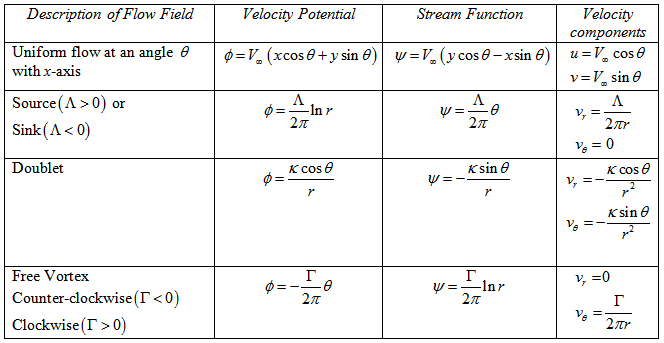
The potential flows are governed by the linear partial differential equation commonly called as “Laplace Equation”. The elementary basic plane potential flows include uniform flow, source/sink flow, doublet flow and free vortex flow. The details of these flow fields have already been discussed and are summarized in the following Table 3.6.1. A variety of interesting potential flow can be obtained by combination of velocity potential and stream function of basic potential flows.
In an inviscid flow field, a streamline can be considered as a solid boundary because there is no flow through it. Moreover, the conditions along the sold boundary and the streamline are the same. Hence, the combinations of velocity potential and stream functions of elementary flows will lead to a particular body shape that can be interpreted as flow around that body. The method of solving such potential flew problems is commonly called as, method of superposition .
Table 3.6.1: Summary of basic, plane potential flows
Combination of a Uniform Flow with a Source
A source of strength  , located at origin is superimposed with a uniform stream with velocity
  as shown in Fig. 3.6.1. The resulting stream function can be written as,
 |
(3.6.1) |
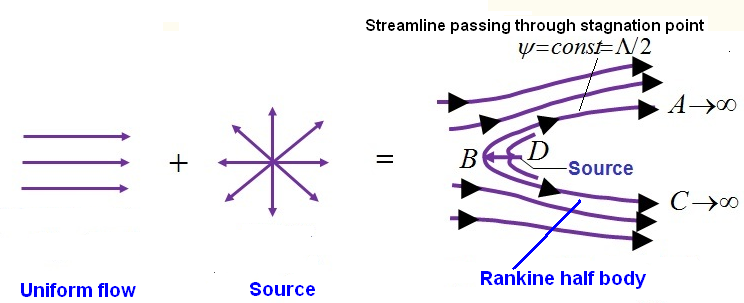
Fig. 3.6.1: Superposition of uniform flow and a source.