|
Non-Renewable Resources
|
In order to get the optimal solution economics principles underlying the
analysis of non-renewable resource scarcity we will use the model by Hotelling.
According to the classic article published in 1931 by Hotelling, for non-renewable
resources our main objective should be the allocation of a given amount
of resources stock over different moments of time in order to maximize
the utility or benefit from consuming the resource. Even though during
the last several years the economic analysis become much more complicated
but the basic insight remains the same.
Since the size of non-renewable resources is fixed, consuming and extracting a unit of the resources implies that there is less of the stock of resources for future consumption. Thus, in addition to extraction costs, there is another kind of cost associated with it i.e. the reduced level of future benefit due to fewer resources being available called ‘royalty’ or ‘users cost’. Hotelling assumed that.
- The marginal utility of consuming the resources is decreasing.
- Marginal extraction cost constant.
This means that along an economically optimal expansion path the marginal utility of consuming the resources must be equal to the sum of constant unit of extraction costs and the royalty. Thus marginal utility of using the resources is greater than the marginal cost of extracting the resources and difference is royalty. It reflects the value of an un extracted marginal resources unit with respect to future consumption possibilities. This ‘Royalty’ cost implies the fact that the society must be much more conservative in consuming non-renewable resources compared to other ordinary goods the production cost of which do not include royalty.
The concept of royalty and optimum utilization decision is explained in fig C1. On the vertical axis we measure marginal utility from consuming the resources marginal cost of extracting the resources whereas the horizontal axis we measure the level of resources utilization over one year.
Here, MU curve shows the marginal utility of consuming the resources,
which is diminishing. For normal commodities (whose stock is not prefixed)
the optimal production occurs at Q** where marginal utility of the resources
equal marginal cost. How ever for non-renewable resources this will not
be the case since today’s consumption of the resources involves
opportunity costs, Royalty. At the level of royalty (AB) the optimal level
of resources extraction and consumption is Q*
. 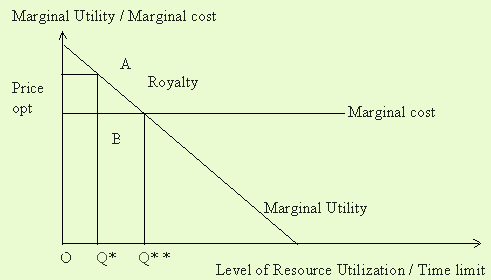
Fig C1: Optimum Resource Utilization
We need to analyse the question that how the level of royalty evolves over time. According to ‘the Hotelling rule’ royalty must increase wit h time at rate equal to the rate of discount. This means that the net marginal utility of consuming the resources must also increase at a rate equal to the rate of discount. This implies the fact that from the current point of view the net benefits from the marginal units consumed in every period (the discounted value of net utility) are equal/same. Again the equality emphasizes the fact that it is not possible to increase the total level of discounted net utility from resources consumption via changing the extraction of the resources over time. Thus ‘the Hotelling rule’ established that royalty increases exponentially and the level of resources utilization decrease over the time. The higher (lower) the rate of discounts the higher (lower) the rate at which the level of resource consumption falls over time.
Up to now we have discussed optimal renewable resource utilization only when the rate of resources utilization can be directly controlled by the government or society.
But in a market economy profit maximizing private firms usually utilize resources. Now the question is how the level of resource utilization will be affected by this owner ship?
In contrast to our general idea, Hotelling shows that private ownership will not accelerate resources utilization. The reason behind this is as follows since the marginal utility curve shows the maximum amount that consumers (or firms who use the resources as input) are willing to pay for consumption of another unit of the resources it is also the demand curve of the industry in the market. To maximise the present value of profit the industry must apply such a rate of extraction that royalty increase exponentially over time. This means that the industry will also follow a resources extraction policy that maximises the profit for the industry “the socially optimal resource utilization policy”.
The higher the level of royalty the higher will be the market price of the resources which implies that market price of non-renewable resources must increase over time.
A project will be profitable if the benefits of the project exceed the costs. The concept of profitability requires calculation of the stream of a project is future benefits and costs period by period and conversation of this stream of benefits and costs into some simple measure expressed as a number. The commonly used measures are the net present value (NPV) and the internal rate of return (IRR). The net present value may be define as:
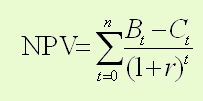
Where  are
benefits in year t ;
are
benefits in year t ; are
costs, including investment in year t
are
costs, including investment in year t
r is the rate at which future benefits and costs are discounted
;n is the life of the project
Discounting reduces the value of future benefits and costs. Why future benefits and costs are discounted and how is this rate of discount determined? The answer to the first part of the question is that cash received in the future is less valuable than the same amount of cash received immediately because in the interim the firm could invest these funds and earn interest on them. For a private individual or firm the correct rate of discount is the market rate of interest. If a firm can lend at 10 percent it would have no reason to choose a project that costs Rs. 1000 today and yields only Rs. 1080 next year because by lending this amount it would get Rs. 1100 next year. Similarly if it barrows at 10 percent it would not invest in such a project which fields only 8 percent return. On the other hand a firm would have no reason to reject a project that costs Rs. 1000 today and yields Rs. 1110 next year. Even if it does not have the money it can borrow it at 10 percent and make net profit of Rs. 10. As long as a project has a positive NPV it is considered desirable. If funds are available a firm should select those entire project which have positive NPV. If however because of resource constraints a firm has to choose one project out of several competing projects the one with the highest NPV should be selected. A positive NPV means that benefits of a project are higher than costs. This ratio of benefits to costs in that case would be greater than 1.
The benefit cost ratio (BCR) is defined as
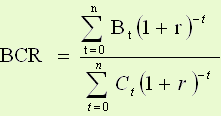
Thus serves the same purpose as the NPV a measure of project desirability. An interest rate for which the net present value of a project is zero is called the “internal rate of retrieve (IRR)” of the project. The IRR is an alternative measure of project desirability. A project with an IRR higher than the market rate of interest is considered desirable project. If NPV of project at alternative discounts rates is plotted as shown in Fig. 1 point A gives the IRR for the project.
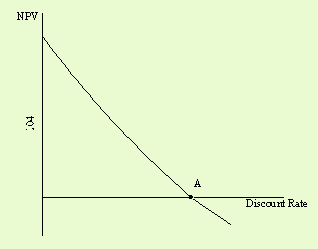
Fig 1: NPV at alternative discount Rates
One difficulty with the IRR criteria is that it is quite possible that the NPV of a project may become zero at more than one rates of interest i.e. a project may have several internal rates of return. However, if a project incurred negative net cash glows up to a certain point in time (when initial investments are made) and there after yielded positive net cash flows, its IRR would be unique. For this reason the problem of multiple internal rates of return is not considered very serious.
Which one of the two measures NPV or IRR is a better measure of project desirability? If choice of one project does not rule out another, we can use either of the two selection rules they both will give same answer so long as NPV always goes down as the discount rate is raised. If the market rate of interest is lower than the IRR, the NPV of a project will be positive. Such a project should be selected.
The problem arises when all desirable projects cannot be undertaken. In such a situation the two decision criteria may provide conflicting choices. This is illustrated in fig.2: -
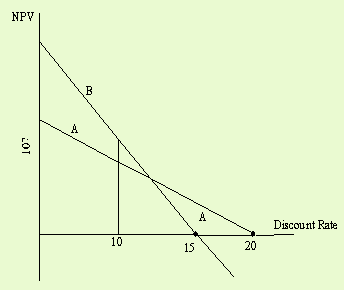
Fig. 2: NPV and IRR Criteria
Project A has 20% IRR whereas for project B, the IRR is 15%. Thus by the IRR criteria project A is better. However at 10% rate of discount, Project B is preferable to Project A by the NPV criteria.
If the market rate of interest at which the firm borrows is known with certainty, it is better to use the NPV criteria than the IRR. The NPV criteria are better than the IRR for one more reason: the former provides a measure of total gains which the latter does not. When cost- benefit analysis is employed by a private firm to assess a project, market prices of inputs and outputs are used in calculations of costs and benefits of the project. This commercial profitability criteria is however not suitable for assessing public sector projects, because for various reasons elaborated below the market prices of inputs and outputs do not necessarily reflect their social costs and social value respectively. In order to allocate resources in a way most profitable to society, social cost benefit analysis in recommended for the appraisal of public sector projects.
Market prices of goods, labour, foreign exchange and capital may be distorted through taxes, subsides, tariffs and import quota and government control of various kinds such as minimum wages, interest rate controls and price controls. Prices set by monopolists and public utilities are also distorted, as they are different from competitive market prices. Because of the presence of externalities market prices of goods do not reflect their true social value. The externalities could be positive or negative. Externalities refer to the effects that work outside the market. Positive externalities occur when it is not possible to charge the beneficiaries for the benefits they receive. It may be for several reasons: access to the facilities may be difficult and costly to control; An example of such a situation is when a firm trains the labour force in the region. This may not enhance the firm’s profits since after training the workers are free to leave. Large infrastructure projects such as dams, roads and railroads have important positive externalities. For example in case of a hydroelectric dam many people not connected with the project also derive substantial benefits. The downstream farmers may witness increased production become the dam prevents floods. May other cases of positive externalities could be cited however it is the negative externalities, which are concern because they are more prevalent, and have very severe adverse social impacts. Negative externalities occur when firms or individual do not pay for damages their actions cause to other industrial firms for example give rise to negative externalities in polluting air and water. It is a serious problem not only in the industrial world but also in the developing countries since the firms do not bear the cost inflicted on the society by pollution, their profits do not decrease. Externalities are very important in social decision-making. Their presence provides a sufficient reason why commercial profitability should not be used as a guide in public policy.
Market prices may diverge from their social values because of the fact
that the prices of factors of production may not reflect the opportunity
costs of using these factors. Take the case of labour in developing countries;
unskilled workers in modern sectors often get wages which are much higher
than what the opportunity cost criteria would suggest. In these developing
countries there is widespread under employment of labour in rural sector.
When modern industrial sector or government draws labour from the rural
sector its opportunity cost if the loss of output in the rural areas i.e.
labour’s marginal contribution to production, which is quite low.
The wages paid to these unskilled workers are much higher. The domestic
market price of the other primary factor, capital also tends to be distorted
in developing countries. The capital market intermediates between those
making saving and investment decisions. In a perfect capital market the
social return from one unit of current drawings is equal to the social
values of one unit of current consumption at the margin. In the absences
of market distortions this equality between the two sides is established
through market rate of interest. The distortions are caused by the presence
of monopolistic elements and government intervention (fiscal distortions).
Further more in many developing countries export earnings and foreign
investment are not adequate to meet import requirements. Scarcity of foreign
exchange is a serious problem in many developing countries with chronic
balance of payment problems. It is observed that in these counties, quite
often official exchanges rates over value local currency. It does not
reflect the real scarcity of foreign exchange. There are several interest
rates prevailing in the market at the same time. The differences in interest
rate are too enormous to be justified as the basis of differential risks.
These are caused by capital market rigidities.
Price distortions can possibily be removed by suitable fiscal methods
of lump sum taxes and subsidy. But for various reasons it is very difficult
to implement such policies and they are usually not undertaken. If price
distortions in the economy cannot be removed then project appraisal method
should be such that corrects for price distortions. Instead of using market
prices, which are distorted, it is recommended to use imputed values,
which reflect real opportunity costs to the society in cost-benefit analysis
of the projects. This is referred to as shadow pricing.
Shadow prices are determined by the interaction of national objective of the resource constraints facing the economy. Shadow price, i.e. opportunity costs of a resource, which using scarce tends to be high. The reason for high opportunity costs is that such resource have many competing uses and the forgone benefit in the best alternate that must be given up is high. On the other hand, shadow price of a resource available in abundance will tend to be low. Shadow prices usually differ significantly from market prices in developing countries because for various reasons noted above, market prices are distorted and thus do not correctly reflect scarcity of resources.
As discussed earlier, the opportunity cost of labour in a labour surplus economy is very low. Labour in modern sector is, however paid considerably more than its opportunity cost. The shadow wage, lies somewhere between the opportunity costs of labour (equal to its marginal productivity) and the industrial wage.To settle on a particular figure however, requires a great deal of judgement. It is a common practice to use a specific conversion factor (or the standard conversion factor) to convert market rate into shadow wage.
As discussed above, official foreign exchanges rate in many developing countries overvalues local currency. In social cost benefit analysis a corrected exchange rate, referred to as shadow exchange rate which reflects the true opportunity costs of foreign exchange is used. One method of calculating shadow exchange rate involve comparison of the domestic prices of imported commodities with the official foreign exchange prices of there commodities. For example, if an import item can be sold in the domestic market at a price which is 50% higher than the price calculated on the basis of official exchange rate, it means that the domestic currency if overvalued by 50%. It should be devalued by 50% to reflect its true value.
In the conventional approach the social cost-benefit analysis all traded and non-traded goods are measured in one currency either foreign or local. Traded goods in foreign prices are converted into domestic prices or alternatively non-traded goods in domestic price are converted into foreign prices using shadow exchange rate.
An alternate approach recommended by Little and Mirrlus requires that all goods should be valued at world prices because these represent a country’s actual trading opportunities. It is argued that is a better measure of the social valuation of goods than the other non-traded goods at domestic price and traded goods at their international price. In the latter method domestic and foreign goods are made comparable using a shadow exchange rate, which may itself be distorted.
There is no need to calculate shadow exchange rate if all goods traded and non-traded are measured at world prices. The values of goods can be expressed in any currency local or foreign. Since all values will retain a constant relationship to each other it does not matter what currency they are measured. The values can be converted form one currency to other using any exchange rate.
Non-traded goods are those, which normally cannot be imported. For example, electricity, construction, local transport and labour are non-traded goods or inputs. Since these goods are not traded internationally their valuation at ‘world prices’ poses a problem. The way out is to take each non-traded input and break it down into traded and non-traded components. The latter are in turn broken down into traded and non-traded components. This way it is possible, at least theoretically, to reduce all non-traded inputs and goods into traded items. Land is not considered very important in industrial projects. Regarding labour it is argued that it can be valued in terms of its own inputs (i.e. into consumption) which consist of traded items. A detailed input output table for the economy, as a whole is required to conduct these exercises. Such a table will however be available only in a few developing countries. Some critics have pointed out that all this trouble of conversion of non-traded items into traded items in order to avoid using a foreign exchange rate official or shadow, is not worth it. The cure, it is alleged is worse than the disease. It may be just as accurate to use properly adjusted shadow exchange rate to convert values in domestic currency into foreign currency.
|
|