EXAMPLES OF NATURAL RESOURCES

Among these three kinds of natural resources we will now concentrate on the optimal use of renewable and non-renewable resources.

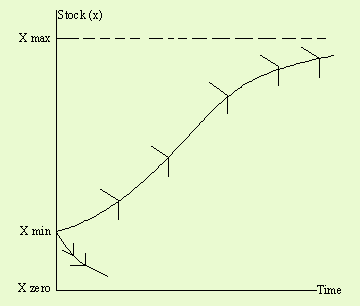
Renewable Resources : To obtain an optimal solution let us consider a single fish species and assume that its stock (or biomass) exhibits a logistic growth through time shown in fig 1. The curve shown is logistic function: at low level of stock the fish multiply, but as they begin to complete for food supplies their rate of growth slows down and eventually the stock converge on some maximum level X max, the ecosystem is carrying capacity for the species.


Table 1: Examples of natural Resources
Physical Properties
Availabilty
Biological
Non-Energy
Energy
Environment
Expendable
Most agricultural products for example corn, grains
Salt
Solar radiation Hydro power ethanol
Noise pollution Non-persistent air water pollution
Renewable
Forest product fish live stock harvested wild wood animal wood whales flowers insects
....
Wood for burning Hydropower geothermal power
Groundwater air persistent Air and water pollution forests.
Depletable
Endangered species
Most minerals for example gold, iron ore, bauxite top soil
Petroleum natural gas coal uranium oil shall
Virgin wilderness ozone layer water in some aquifers.

Fig 1: Logistic growth curve of a renewable resource.


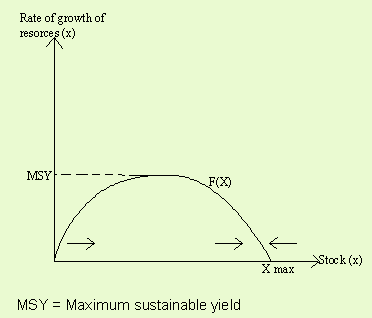
Fig 2: Pure compensation growth curve

The curve begins at X min, which is the critical minimum level of population. If the members go below this level the species is driven to extinction (X zero). Now if we assume that there is no critical minimum population ignore the segment of the curve in fig 1 between X min and X zero, then fig 2 plot the same information as in (1), with X = the rate of change in X with respect to the time the growth of the resources on the vertical axis and X = the level of stock on the horizontal axis.

Fig. 2 shows that the rate of growth of the resource stock is positive at the first, reaching a maximum and then declines as the stock gets bigger.

Thus if we leave the resources alone it will grow continuously in size in terms of its total biomass until it reaches the carrying capacity of its environment at X max, where the growth rate of the resources reaches a maximum. This point (X max) represents the ‘maximum’ sustainable yield (MSY) of the resource.

This concept is important because if we harvest the renewable resources in such a way that it is equal to the MSY: the resources will regenerate itself and reviews for ever. The level of exploitation or harvest (or yield) of the resources is expressed as. The effort expended in harvesting and is equal to the ratio of the actual harvest H, to the sock X.

That is, (1)

The larger the effort, the greater the proportion of the stock that would be harvested. We can rewrite this equation as H = EX (2)

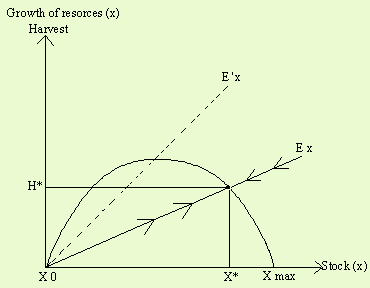
The rate of harvest is shown in fig 3, which shows how the choice of the effort level will determine the harvest (H) and the stock level (X) i.e. where ‘EX’ is equal to the rate of growth of the resources.

Any harvest level along the line EX to the right or left of X* will mean that the harvest is greater (lesser) than the sustainable field through natural regeneration and the stock will fall (grow). (It should be noted here that H* is not the maximum sustainable yield but we could easily introduce a management policy which says that effort should be changed so as to take the MSY. Here E becomes the instrument of management and the harvest rate is set equal to E ‘x as in fig: (3).

Thus introducing the effort level helps us to determine the harvest and stock level but tells us nothing about the desirable level of exploitation. To get this we need to introduce the concepts of costs and revenues.


Fig 3: Effort growth equilibrium

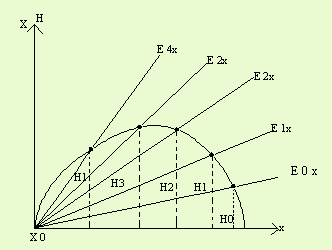
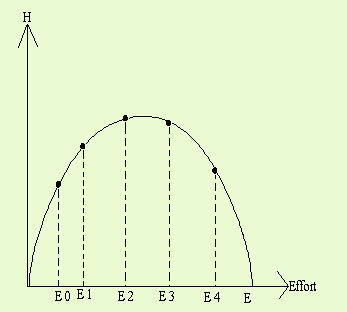
In order to do this we transform fig: (3) into fig: (4) showing the relationship between the harvest or yield and the level of effort. In fig: (4 a) we find various equilibrium for various degrees of effort where E4>E3>E2>E0 (E is the slope of the line E x). Now plotting the levels of the effort in the horizontal axis of fig 4 b and the associated harvest levels in the vertical axis, we get the effort harvest (or effort yield curve).

This curve looks very much like growth harvest curve and the yields are read off from fig: (4 a) in such a way that they appear mirror image of the lower half. Thus, X max corresponds to zero effort and X o to E in fig 4.


4 a

4 b

Fig 4: From growth effort to the effort harvest function.


Now, if we assume that effort is the only factors of production involved then total cost, TC, will be equal to the level of effort multiplied by the prices of effort (W). If the wage rate (W) is assumed to be constant then TC = WE 3. Also if the price of the harvested product is constant at P, then total revenue (TR) from the harvest will be TR = PH 4. Since P and W are assumed constant the total revenue curve will have the same shape as the effort harvest function in fig: (4) the total cost function with a constant slope equal to the wage rate or “price per unit effort” is shown in fig: (5).
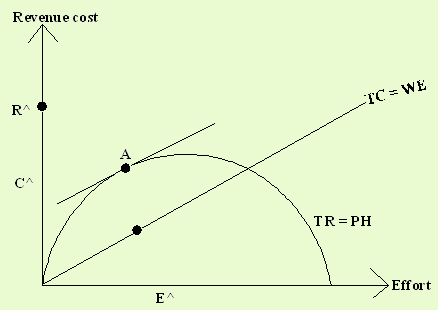

Fig: 5(a) profit maximum
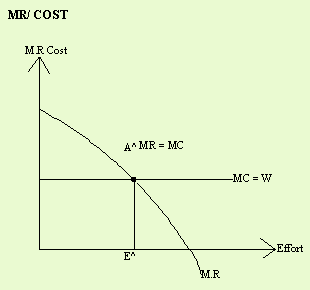

Fig: 5(b) marginal conditions

Now, for profit maximization producer requires :

1) maximum to the difference between TR and TC or
2) slope equate marginal revenue (MR) with marginal cost (MC) and the MC must have a steeper slope than MR curve or MC must cut MR from below (shown in fig 5b).
Under the profit maximization hypothesis two possible equilibrium are possible (shown fig 6).

  1. Common property equilibrium.
  2. Open access equilibrium.

A common property equilibrium or resource is one that is owned by some defined group of people a community or a nation. It is possible that within this group of people there will be open access and it is harvested.
An open access equilibrium or property means that no one owns the resources and access is open to all. There are no limit on new entrants (e.g. sea fisheries).  
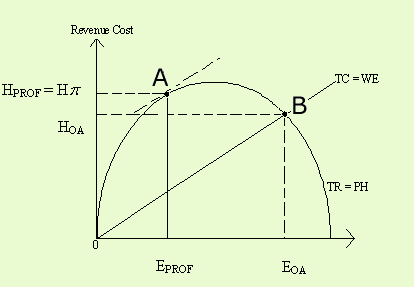

Fig: 6 Profit maximization and open access equilibrium

If the renewable resources can be placed under single ownership or joint ownership in such a way that the owners’ act collectively, we can assume that the resources will be managed to maximise profit. In the fig: (5a) and (6);
A is the point of maximum profit with H PROF = Hπ = as the harvest rate
Eπ = as the effort rate

However private ownership is not typical or applicable for all the resources e.g. major forest or sea fishes. Instead we may have either territorial ownership or no territorial ownership (Internationally common property). In either case we get the ‘Open access solution’.

Here, if less than normal profit are being made (TR<TC) some resource exploiters will go out of business and if abnormal profit (TR>TC) are being earned new entrants will come in. At equilibrium profits point are dissipated (TR =TC) and each resources exploiter recurs normal profit only. In fig: (6) equilibrium is at point B with a harvest rate HOA and effort rate EOA equal.

From the two-equilibrium solution it can be said that the profit maximization solution can only be optimal in the social sense if the preference of conservation imply zero ‘preservation value’ for the resource. In order to get socially optimal solution we try to accommodate externalities in our analysis. For example, if conservationists prefer larger to smaller stocks their utility loss will be a function the difference between the maximum possible stock (the natural equilibrium or carrying capacity stock) and the actual stock that results from the amount resources use.

UC = f (Xmax – XE)
Where UC = the loss of utility of the conservationists & XE = the various equilibrium levels of stock.

The valuation function consistent with this function is shown in fig: 7. How ever we should remember that depending upon the ‘reference point’ (here X max) the valuation function may differ (e.g. if we take X MSY the reference point or most desired point). Now it is most likely that at very low levels of stock the preservation value function will be discontinuous.

From the above discussion we can conclude that the addition of externalities in the normal situation following things happens.

  1. When the aim is to maximise net benefit in contrast to simple profit maximization the optimal stock of the resource will be higher.
  2. If the external costs are very large the resources will be ‘optimally’ managed if it is left alone to reach its natural equilibrium.
  3. Introduction of social cost also does not confer any particular emphasis on the social desirability of the stock levels corresponding to MSY.