| |
We have seen that Bragg diffraction occurs for values of  vectors which are multiples of vectors which are multiples of  . Bragg diffraction is a consequence of periodicity of the lattice and diffraction pattern forms a geometric image which bears an inverse relationship with lattice periodicity. Because the scale associated with the points at which Bragg condition is satisfied has the dimensions of inverse length (as seen in the one dimensional relation . Bragg diffraction is a consequence of periodicity of the lattice and diffraction pattern forms a geometric image which bears an inverse relationship with lattice periodicity. Because the scale associated with the points at which Bragg condition is satisfied has the dimensions of inverse length (as seen in the one dimensional relation  ), the geometrical structure defined by diffraction peaks is called the reciprocal lattice corresponding to the real space lattice which is also referred to as the direct lattice . ), the geometrical structure defined by diffraction peaks is called the reciprocal lattice corresponding to the real space lattice which is also referred to as the direct lattice . |
| |
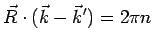
An equivalent way of describing diffraction in crystal is known as von-Laue formulation, according to which the condition of constructive interference is satisfied if |
| |
where  is a direct lattice vector, is a direct lattice vector,  is the wave vector of the incoming wave, is the wave vector of the incoming wave,  that of outgoing wave and that of outgoing wave and  is any integer. is any integer. |
| |
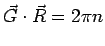
One can define reciprocal lattice vector  |