 |
We have seen that the solution of the Schrödinger equation for an arbitrary value of  is a plane wave is a plane wave  . This, however, is not true at the zone boundary where Bragg reflection takes place. At such a boundary the wave function has two components, viz., and . This, however, is not true at the zone boundary where Bragg reflection takes place. At such a boundary the wave function has two components, viz., and  . One can form two standing waves using these two wavefunctions, viz., . One can form two standing waves using these two wavefunctions, viz., 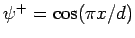 and and 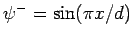 . The corresponding electron densities are proportional to . The corresponding electron densities are proportional to  and and  . These two densities have their maxima respectively at the locations of the atoms and midway between atoms, as shown. . These two densities have their maxima respectively at the locations of the atoms and midway between atoms, as shown. |

