Module 2 : Molecular Structure
Lecture 11 : Non-covalent interactions 2 : Structures of Liquids
  11.3

Computer simulation in liquids.

A knowledge of the properties of liquids is essential for doing most of chemistry, chemical engineering and biology. While it is not possible to build the theoretical framework for this purpose here, we will outline the principles used in computer simulations which are being used widely nowadays.

 
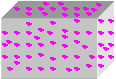
Imagine a beaker containing a few moles of water. The system contains about 1024 molecules. No computer's memory can handle so many molecules today. Imagine a tiny segment out of this huge number, say about 200 molecules contained in a cubical box as shown below in fig 11.3
 

Figure 11.3 (a) About a hundred molecules in a cubical box.
Figure 11.3 (b)

 
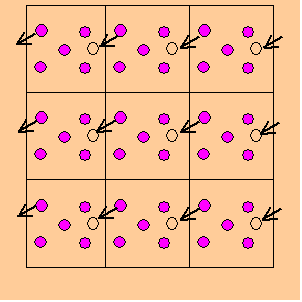
Figure 11.3 (b) A two dimensional box showing periodic boundary conditions.
 
Imagine the central box in fig 11.3 (a) to be surrounded by identical boxes in the x, y and z directions so as to fill space. The positions of the particles in the central box are arbitrary to begin with and the positions of the particles in other boxes are replicas of the central box. If a molecule moves out of the central box to one side, the corresponding image molecule from the box on the opposite side enters the central box so that the density (number per volume) in the box is unchanged. In this manner, we have generated a bulk fluid [of course it differs from the actual liquid because of the periodicity of fig 11.3 (b)]; but the results of the simulations indicate that a fairly accurate description of fluids is obtained by these techniques.
 
The major task that remains is to generate the motion of these molecules (as in the real liquid)by using suitable algorithms and then obtain appropriate distribution functions and from these, get the macroscopic properties of the liquid.