The interaction between two molecules is the sum of the nine Coulombic interactions (interaction of each charge on one molecule with each of the three charges on the other molecule) plus an additional LJ interaction between the two oxygens given by |
|
| ULJ0-0 (r) = ( B / r )12 - ( A / r )6 |
(11.14) |
|
| The values of A and B are 0.37122 (kJ/mol)1/6nm and 0.3428 (kJ/mol)1/12 nm, and r is the distance between two oxygens. 1nm = 10 -9 m. Although the bond angle in this model is higher than the value of the bond angle in the vapour phase and the dipole moment too is different from the vapour phase value of 1.8 D, this model predicts good structure for liquid water. One of the simple message is that the molecular structure and geometry in a liquid gets affected by the presence of the densely packed neighbouring molecules. |
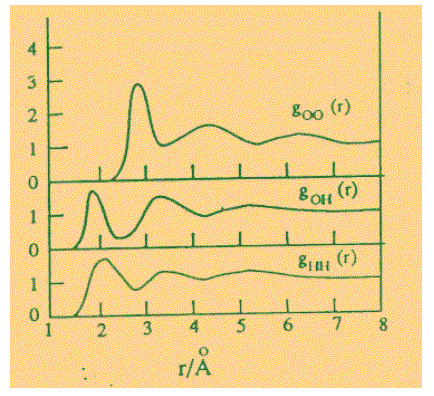
| The distribution functions g(r), now get extended to gHH (r), gOO (r) and gOH(r). In goH(r), the oxygen is on one water molecule and H on another water molecule. These distribution functions are shown in fig 11.6
|
| |
|
| |
| Fig 11.6 The O-O, O-H and H-H pair distribution functions in water. |
| |
From these functions we can obtain, among other things, the coordination number around each water molecule, i.e., how many water molecules surround a given water molecule at a distance, say 3 . This is given by . This is given by |
| |
coordination number at 3 = 4  g(r)r2dr g(r)r2dr |
(11.15) |
| |


