Module 2 : Molecular Structure
Lecture 11 : Non-covalent interactions 2 : Structures of Liquids
  11.2  

Structure of liquids

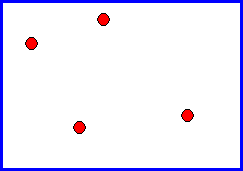
In Fig 11.1, a small segment of the structure of gases, liquids and solids are shown. The actual box extends to at least a few millimeters. Only a 10 -20 section in a plane is shown. We see that in a gas, there are very few molecules separated considerably from one another and there is hardly any "local structure" that has developed.


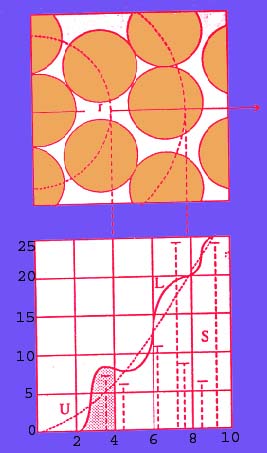
Figure 11.1 A box showing molecules of a gas.                            Figure 11.1 (a) The structure of liquid sodium.
 
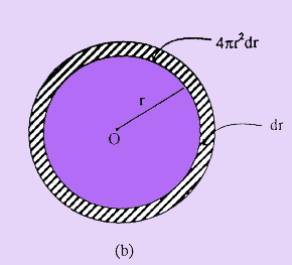
Figure 11.1 (b) A section of a spherical shell of radius r and thickness dr.

The other extreme is the case of a solid where there is "perfect" (in the case of a perfectly crystalline solid at 0 K) order and nothing moves. If we know the position of a single atom /molecule and the lattice spacings in three directions, we can precisely predict the location of all the other atoms in the solid. The case of a liquid is intermediate. Although each molecule is surrounded by other molecules, all are moving. To study an equilibrium property, we can ask questions such as how many nearest neighbours does a molecule have, on the average, and how many second nearest neighbours and so on and then relate the equilibrium property to these average numbers.

A more general query would be how many neighbours are there at a given distance r from a central atom /molecule.To find out this number a spherical shell of radius r and thickness dr is constructed around at atom at the origin. The volume of this shell is (4/ 3) (r+dr)3- (4/ 3) r3 which is equal to 4 r2dr. We count the number of atoms n(r) in this spherical shell. The local density (r) at a distance r from the central atom will then be

(r) = n(r) / ( 4 r2 dr) (11.1)