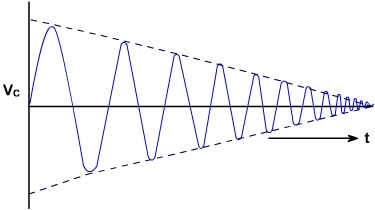
The circuit discussed is not a practical oscillator because even if loss less components were available, one could not extract energy with out introducing an equivalent resistance. This would result in damped oscillations as shown in fig. 3.
Fig. 3
These oscillations decay to zero as soon as the energy in the tank is consumed. If we remove too much power from the circuit, the energy may be completely consumed before the first cycle of oscillations can take place yielding the over damped response.
It is possible to supply energy to the tank to make up for all losses (coil losses plus energy removed), thereby maintaining oscillations of constant amplitude.
Since energy lost may be related to a positive resistance, it follows that the circuit would gain energy if an equivalent negative resistance were available. The negative resistance, supplies whatever energy the circuit lose due to positive resistance. Certain devices exhibit negative resistance characteristics, an increasing current for a decreasing voltage. The energy supplied by the negative resistance to the circuit, actually comes from DC source that is necessary to bias the device in its negative resistance region.
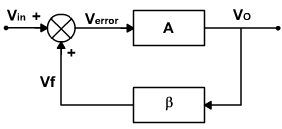
Another technique for producing oscillation is to use positive feedback considers an amplifier with an input signal vin and output vO as shown in fig. 4.
Fig. 4
The amplifier is inverting amplifier and may be transistorized, or FET or OPAMP. The output is 180° out of phase with input signal vO= -A vin.(A is negative)
Now a feedback circuit is added. The output voltage is fed to the feed back circuit. The output of the feedback circuit is again 180° phase shifted and also gets attenuated. Thus the output from the feedback network is in phase with input signal vin and it can also be made equal to input signal.
If this is so, Vf can be connected directly and externally applied signal can be removed and the circuit will continue to generate an output signal. The amplifier still has an input but the input is derived from the output amplifier. The output essentially feeds on itself and is continuously regenerated. This is positive feedback. The over all amplification from vin to vf is 1 and the total phase shift is zero. Thus the loop gain A β is equal to unity.
When this criterion is satisfied then the closed loop gain is infinite. i.e. an output is produced without any external input.
vO = A verror
= A (v in + v f )
= A (vin + β vO)
or (1-A β )vO = A vin
or
When A β = 1, vO / vin= ¥
The criterion A β = 1 is satisfied only at one frequency.This is known as backhausen criterion.