Properties
of the discrete Fourier transform |
Since discrete Fourier
transform is similar to the discrete Fourier series
representation, the properties are similar to DFS representation.
We use the notation |
| |
to say that  are
DFT coefficient of finite length sequence. are
DFT coefficient of finite length sequence. |
1. Linearity |
If two finite length
sequence have length M and N , we can consider
both of them with length greater than or equal to maximum
of M and N. Thus if |
| |
| |
then |
| |
where all the DFTs
are N-point DFT. This property follows directly from
the equation (6.20) |
2. Circular
shift of a sequence |
If we shift a finite
length sequence  of
length N , we face some difficulties. When
we shift it in right direction of
length N , we face some difficulties. When
we shift it in right direction  the
length of the sequence will becam the
length of the sequence will becam  according
to definition. Similarly if we shift it left according
to definition. Similarly if we shift it left  , if
may no longer be a finite length sequence as , if
may no longer be a finite length sequence as  may
not be zero for n < 0. Since DFT coefficients are
same as DFS coefficients, we define a shift operation
which looks like a shift of periodic sequence. From may
not be zero for n < 0. Since DFT coefficients are
same as DFS coefficients, we define a shift operation
which looks like a shift of periodic sequence. From  we
get the periodic sequence we
get the periodic sequence  defined
by defined
by |
| |
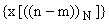
We can shift this sequence by m to get |
| |
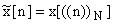
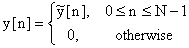
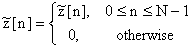
Now we retain the first N values
of this sequence |
| |
This operation is shown in figure below for m =
2, N = 5. |
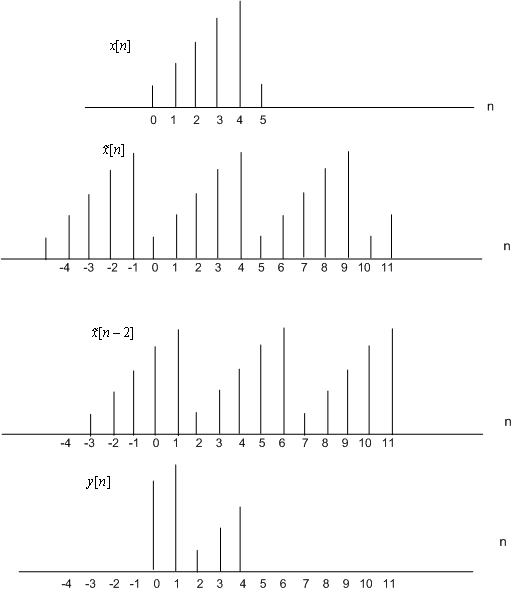
Fig 6.1
|
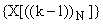
We can see that  is
not a shift of sequence.
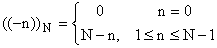
Using the propertiesof the modulo arithmetic we have is
not a shift of sequence.
Using the propertiesof the modulo arithmetic we have |
|
and |
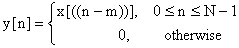 (6.23) |
The shift defined in
equation (6.23) is known as circular shift. This is
similar to a shift of sequence in a circular register. |

Fig 6.2
|
3. Shift property
of DFT |
From the definition
of the circular shift, it is clear that it corresponds
to linear shift of the associated periodic sequence
and so the shift property of the DFS coefficient will
hold for the circular shift. Hence |
 (6.24) |
and |
 (6.25) |
4. Duality |
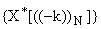
We have the duality
for the DFS coefficient given by  ,
retaining one period of the sequences the duality property
for the DFT coefficient will become ,
retaining one period of the sequences the duality property
for the DFT coefficient will become
|
| |
5. Symmetry
properties |
We can infer all the
symmetry properties of the DFT from the symmetry properties
of the associated periodic sequence  and
retaining the first period. Thus we have and
retaining the first period. Thus we have |
| |
and |
| |
We define conjugate
symmetric and anti-symmetric points in the first period
0 to N - 1 by |
| |
| |
Since |
| |
the above equation
similar to |
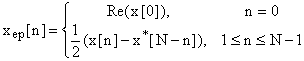 (6.26) |
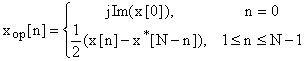 (6.27) |
| |
 and and  are
referred to as periodic conjugate symmetric and periodic
conjugate anti-symmetric parts of.
In terms if these sequence the symmetric properties
are are
referred to as periodic conjugate symmetric and periodic
conjugate anti-symmetric parts of.
In terms if these sequence the symmetric properties
are
|




|
6. Circular
convolution |
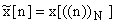
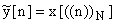
We saw that multiplication
of DFS coefficients corresponds of periodic convolution
of the sequence. Since DFT coefficients are DFS coefficients
in the interval,  ,
they will correspond to DFT of the sequence retained
by periodically convolving associated periodic sequences
and retaining their first period. ,
they will correspond to DFT of the sequence retained
by periodically convolving associated periodic sequences
and retaining their first period. |
|
Periodic convolution
is given by |
using properties of
the modulo arithmetic |
| |
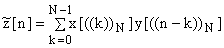
and then |
| |
Since  we
get we
get |
| |
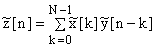
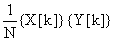
The convolution defined
by equation (6.28) is known as N-point-circular convolution
of sequence  and and  ,
where both the sequence are considered sequence of
length N. From the periodic convolution property of
DFS it is clear that DFT of ,
where both the sequence are considered sequence of
length N. From the periodic convolution property of
DFS it is clear that DFT of  is.
If we use the notation is.
If we use the notation  to
denote the N point circular convolution we see that to
denote the N point circular convolution we see that |
 (6.29) |
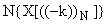
In view of the duality
property of the DFT we have |
 (6.30) |
Properties of the Discrete Fourier transform are summarized
in the table 6.2 |
|
Finite length sequence (length N) |
N-point DFT (length N) |
1. |
|
|
2. |
|
|
3. |
|
|
4. |
|
|
5. |
|
|
6. |
|
|
7. |
|
|
8. |
|
|
9. |
|
|
10. |
|
|
11. |
|
|
12. |
|
|
13. |
|
|
14. |
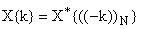
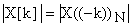
If  is
real sequence |



|
|
| |