These are two important
distinction between continuous time and discrete time
complex exponential. The first one is that harmonically
related continuous time complex exponential  are
all distinct for different values of k , while
there are only N different signals in the
set. are
all distinct for different values of k , while
there are only N different signals in the
set. |

 is
a periodic signal with period N, that is
is
a periodic signal with period N, that is 
 in
terms of discrete time complex exponential signals
are given by
in
terms of discrete time complex exponential signals
are given by  (6.1)
(6.1)  ,
and thus harmonically related.
,
and thus harmonically related.  are
identical. Thus
are
identical. Thus 
 for
different k have period
for
different k have period
 which
changes with k. In discrete time exponential,
if k and N are relative prime than the
period is N and not N/k. Thus if N is
a prime number, all the complex exponentials given by
(6.1) will have period N. In a manner analogous
to the continuous time, we represent the periodic signal
which
changes with k. In discrete time exponential,
if k and N are relative prime than the
period is N and not N/k. Thus if N is
a prime number, all the complex exponentials given by
(6.1) will have period N. In a manner analogous
to the continuous time, we represent the periodic signal
 as
as  (6.2)
(6.2)  (6.3)
(6.3) 


 and
and  ,
since the signal is periodic with periodic with period
5, coefficients are also periodic with period 5, and.
,
since the signal is periodic with periodic with period
5, coefficients are also periodic with period 5, and.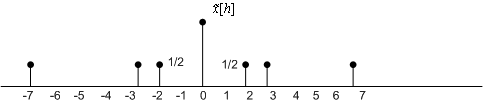

 (6.4)
(6.4)