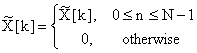
Fourier
Representation of Finite Duration sequence |
The Discrete
Fourier Transform (DFT) |
We now consider the
sequence  such
that such
that 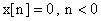 and.
Thus and.
Thus  can
be take non-zero values only for.
Such sequences are known as finite length sequences,
and N is called the length of the sequence.
If a sequence has length M, we consider it
to be a length N sequence where.
In these cases last ( N - M ) sample values are zero.
To each finite length sequence of length N we can always
associate a periodic sequence can
be take non-zero values only for.
Such sequences are known as finite length sequences,
and N is called the length of the sequence.
If a sequence has length M, we consider it
to be a length N sequence where.
In these cases last ( N - M ) sample values are zero.
To each finite length sequence of length N we can always
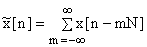
associate a periodic sequence  defined
by defined
by |
 (6.16) |
Note that  defined
by equation (6.16) will always be a periodic sequence
with period N, whether defined
by equation (6.16) will always be a periodic sequence
with period N, whether  is
of finite length N or not. But when is
of finite length N or not. But when  has
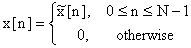
finite length N, we can recover the sequence has
finite length N, we can recover the sequence  from from  by
defining by
defining
|
 (6.17) |
This is because of  has
finite length N , then there is no overlap
between terms has
finite length N , then there is no overlap
between terms  and and  for
different values of. for
different values of. |
Recall that if
n = kN + r, where 
then n modulo N = r ,
i.e. we add or subtract multiple of N from n until
we get a number lying between 0 to N - 1.
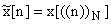
We will use ((n))N to denote n modulo N.
Then for finite length sequences of length N equation
(6.16) can be written as |
 (6.18) |
We can extract  from from  using
equation (6.17). Thus there is one-to- one correspondance
between finite length sequences using
equation (6.17). Thus there is one-to- one correspondance
between finite length sequences  of
length N , and periodic sequences of
length N , and periodic sequences  of
period N. of
period N. |
Given a finite length
sequence  we
can associate a periodic sequence we
can associate a periodic sequence  with
it. with
it.
This periodic sequence has discrete Fourier series
coefficients  which
are also periodic with period N. From equations
(6.2) and (6.3) we see that we need values of which
are also periodic with period N. From equations
(6.2) and (6.3) we see that we need values of  for for  and and
 for 0 = k = N - 1.
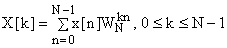
Thus we define discrete Fourier transform of finite
length sequence for 0 = k = N - 1.
Thus we define discrete Fourier transform of finite
length sequence  as as |
| |
where  is
DFS coefficient of associated periodic sequence.
From is
DFS coefficient of associated periodic sequence.
From  we
can get we
can get  by
the relation. by
the relation. |
| |
then from this we can
get  using
synthesis equation (6.2) and finally using
synthesis equation (6.2) and finally  using
equation (6.17). In equations (6.2) and (6.3) summation
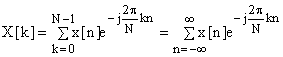
interval is 0 to N - 1, we can write X [k ]
directly in terms of x[n], and x[n]
directly in terms of X[k] as using
equation (6.17). In equations (6.2) and (6.3) summation
interval is 0 to N - 1, we can write X [k ]
directly in terms of x[n], and x[n]
directly in terms of X[k] as |
| |
| |
For convenience of
notation, we use the complex quantity |
 (6.19) |
with this notation,
DFT analysis and synthesis equations are written a
follows |
| Analysis equation: |
 (6.20) |
| Synthesis equation: |
 (6.21) |
If we use values of k and n outside
the interval 0 to N - 1 in equation (6.20) and (6.21),
then we will not get values zero, but we will get periodic
repetition of  and and  respectively.
In defining DFT, we are concerned with values only
in interval 0 to N - 1. Since a sequence
of length M can also be considered a sequence
of length respectively.
In defining DFT, we are concerned with values only
in interval 0 to N - 1. Since a sequence
of length M can also be considered a sequence
of length  ,
we also specify the length of the sequence by saying
N-point-DFT, of sequence. ,
we also specify the length of the sequence by saying
N-point-DFT, of sequence. |
| |
Sampling of
the Fourier transform: |
For sequence  of
length N, we have two kinds of representations,
namely, discrete time Fourier transform of
length N, we have two kinds of representations,
namely, discrete time Fourier transform  and
discrete Fourier transform.
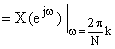
The DFT values and
discrete Fourier transform.
The DFT values  can
be considered as samples of can
be considered as samples of  |
| |
(as x[n] = 0 n < 0,
for n < 0, and n > N - 1) |
 (6.22) |
Thus is  is
obtained by sampling is
obtained by sampling  at. at. |
| |