We can follow a similar argument for each subsequent lower priority class until we reach the lowest priority, i.e. Class 1.
Summarizing, the general results are given below.
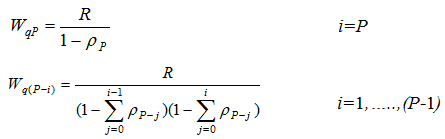
The mean total time spent in system for each priority class will then be given by -

Uisng the above, the parameters Ni and Nqimay be easily found using Little's Result
Residual Life Analysis for a Preemptive Resume Priority M/G/1 Queue
• Consider P priority classes as before with class P of highest priority
• Jobs of priority classes 1,….., ( P -1) may be interrupted by the arrival of new jobs with higher priority
• No loss of work as interrupted job resumes service from point of interruption
• Queueing Delay can be meaningfully defined only for ClassP. For the lower priority classes, this parameter will not be important as a job's service can be interrupted even after it starts service
• The Residual Service Time seen by an arrival will depend on the priority class of the new arrival