Residual Life Analysis for a Non- Preemptive Priority M/G/1 Queue
We assume the following for this analysis.
Number of Priority Classes =P (Class 1 lowest priority
Nqk Number of class k jobs waiting in queue (prior to service)
Wqk Mean waiting time in queue for jobs of priority class k
Note that Little's Result will hold individually for each priority class, i.e. Nqk = λkWqk for class k
R Mean Residual Service Time for job currently served when an arrival (of any priority class) occurs.
Note that in this case, an ongoing service will never be interrupted by a new arrival regardless of their respective priority classes. Therefore the mean residual service time will be the same for arrival from any class and the usual graphical derivation will give -
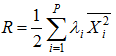
We now consider each priority class separately, in sequence, starting with the highest priority class P and ending with the lowest priority class 1
Class P : For this class, which is the highest, we can see that the waiting time spent in queue will be the sum of the residual service time of the ongoing service (if any) and the time taken to serve all the Class P customers who came before the current arrival. Therefore, we get -
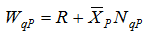
Simplifying this leads to 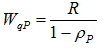
Even though we have used an FCFS argument above, this mean result will hold for any queue as long as the server does not go idle with customers still waiting for service. This approach will be followed for the subsequent priority classes as well.