Offered Traffic for Different Priority Classes of Customers
Based on the arrival rates and service times for the individual priority classes as given in the earlier slides, we can conclude the following regarding the traffic offered for each class and the overall traffic offered to the queue
Traffic of priority class i |
 |
i =1,…..,P |
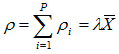
Total Traffic |
 |
|
Condition for the P -Priority M/G/1 Queue to be Stable
For Work-Conserving Queueing Disciplines, the following condition must be satisfied for the queue to be stable for all priority classes
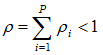
For multi-priority queues, it is possible for the queue to become unstable for lower priority classes while still being stable for the higher priorities.
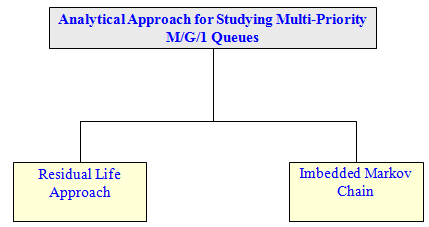
As before, we can adopt either of the two analytical approaches given above to analyze a multi-priority M/G/1 queueing system. The Residual Life Approach is much easier and is illustrated next. Note that this can only give mean results on the delays and the number in the system. The Imbedded Markov Chain approach is also feasible but will be considerably more complex than the former.