- the time required for the holes to move the distance gives a measure
of their mobility, and the spreading of the pulse in a given time gives
a measure of the diffusion coefficient.
- A pulse of excess carriers is created by a light flash at x = 0 in
an n-type semiconductor bar with an electric field E.
- The excess holes drift down the bar and reach the point x = L after
a time
 ,
thus, the drift velocity
,
thus, the drift velocity  ,
and the hole mobility
,
and the hole mobility  .
.
- For measurement of diffusion coefficient, assume the pulse spreads
without drift and neglect recombination; then the diffusion equation
can be rewritten as

- The solution to this equation is the well known Gaussian distribution,
given by

where
the number of holes per unit area created over a negligibly small distance at t = 0.
- Note: the peak values of the pulse decreases and the pulse spreads
in
 directions with
time.
directions with
time.
- Let the peak value of the pulse be at
 and note that at
  ,
,
 is
down by 1/e of its peak value
is
down by 1/e of its peak value ;
thus,
;
thus,

and  ,
where
,
where  ,
where t is the spread of the pulse seen in an oscilloscope in time.
,
where t is the spread of the pulse seen in an oscilloscope in time.
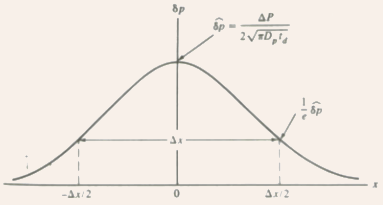
Fig.3.9 The profile of the excess hole concentration after time td.
EXAMPLE A p-type Si sample is used in the Haynes-Shockley experiment. The length of the sample is 2 cm and the two measurement probes are separated by 1.9 cm. The voltage applied across the two ends of the sample is 5 V. A pulse arrives at the collection point 0.608 msec after its injection at the injection point, and the spread of the pulse t at the collection point is 180 sec. Calculate the electron mobility and diffusion coefficient, and verify whether Einstein relation is satisfied.
SOLUTION
The electron mobility

The electron diffusion coefficient

Their ratio
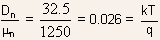
Thus, Einstein relation is indeed satisfied.

- Any combination of drift and diffusion implies a gradient in the
steady state Imrefs.
- Under general case of nonequilibrium electron concentration with drift
and diffusion, the total electron current can be written as

- Using the expression for n(x) in terms of the electron Imref, and
applying Einstein relation, it can be shown that

and, similarly, for holes,
- Therefore, any drift, diffusion, or a combination of the two in a
semiconductor sets up currents proportional to the gradient in the Imrefs,
or, in other words, no current implies constant Imrefs.

3.1 1A 100 mW laser beam with wavelength  nm is focused onto an InP
  sample
100
sample
100  thick. The absorption coefficient at this wavelength is
  .
Find the number of photons emitter per second by radiative recombination
in the sample, assuming 100% quantum efficiency (i.e., each incident
photon creates one EHP, and they spontaneously recombine). What power
is delivered to the sample as heat?
.
Find the number of photons emitter per second by radiative recombination
in the sample, assuming 100% quantum efficiency (i.e., each incident
photon creates one EHP, and they spontaneously recombine). What power
is delivered to the sample as heat?
3.2 A photon of monochromatic light of wavelength 500 nm is
absorbed in  ,
and excites an electron from the valence band into the conduction band.
Calculate the kinetic energies of the electron and the hole.
,
and excites an electron from the valence band into the conduction band.
Calculate the kinetic energies of the electron and the hole.
3.3 Starting from the recombination/generation rate equation,
determine the excess electrons [created in a p-type sample (with equilibrium
carrier concentrations given by p0 and n0) by a high intensity pulse
of light] decay profile as a function of time [i.e.,  ].
Assume high-level injection condition
].
Assume high-level injection condition  State and justify whether
would decay with the same profile till it reaches zero.
State and justify whether
would decay with the same profile till it reaches zero.
3.4 A Ge sample  with
with  is optically excited at 300 K such that
  .
What is the separation of the Imrefs
.
What is the separation of the Imrefs  ?
Clearly draw the band diagram showing the Imrefs and the equilibrium
Fermi level
?
Clearly draw the band diagram showing the Imrefs and the equilibrium
Fermi level  Also, compute the change in the sample conductivity after illumination.
3.5 A sample of p-type Si has a dark resistivity of  at
300 K. The sample is illuminated uniformly to generate
at
300 K. The sample is illuminated uniformly to generate  .
The electron lifetime in the sample is
.
The electron lifetime in the sample is  Calculate the sample resistivity and the percent change in the conductivity
after illumination due to the majority and the minority carriers.
Calculate the sample resistivity and the percent change in the conductivity
after illumination due to the majority and the minority carriers.
3.6 Light is shone uniformly on a  n-type Si sample for a long time to attain steady-state, and the difference
between the electron and the hole Imrefs is found to be 0.55 eV. Now,
the light is suddenly shut off at some arbitrary time (call that t =
0), and the excess conductivity is found to decrease to 10% of its maximum
value at time
n-type Si sample for a long time to attain steady-state, and the difference
between the electron and the hole Imrefs is found to be 0.55 eV. Now,
the light is suddenly shut off at some arbitrary time (call that t =
0), and the excess conductivity is found to decrease to 10% of its maximum
value at time  .
Determine the optical generation rate
.
Determine the optical generation rate  and
the excess hole lifetime
and
the excess hole lifetime  Assume
low-level injection and no trapping.
Assume
low-level injection and no trapping.
3.7 A sample is doped with donors such that  ,
where G is a constant, L is the length of the sample, and
,
where G is a constant, L is the length of the sample, and  Assuming equilibrium, find the built-in electric field in order to sustain
this distribution, and clearly draw the band diagram. Also, plot the
potential V(x) as a function of position.
Assuming equilibrium, find the built-in electric field in order to sustain
this distribution, and clearly draw the band diagram. Also, plot the
potential V(x) as a function of position.
3.8 A 4.63 n-type
Si sample is illuminated uniformly at t = 0 to produce EHPs. Starting
from the continuity equation and assuming low-level injection and no
current flow, determine the expression for the build-up of excess holes
as a function of time. If the excess conductivity at
n-type
Si sample is illuminated uniformly at t = 0 to produce EHPs. Starting
from the continuity equation and assuming low-level injection and no
current flow, determine the expression for the build-up of excess holes
as a function of time. If the excess conductivity at  ;
and after sufficiently long time, it is
;
and after sufficiently long time, it is  ,
determine the optical generation rate and
the excess hole lifetime
,
determine the optical generation rate and
the excess hole lifetime  Assume
no trapping.
Assume
no trapping.
3.9 The following date are obtained from the Haynes-Shockley
experiment on a p-type Si sample at 300 K: length of sample=2cm,length
between injection and collection probes =1.2 cm,applied voltage= Calculate the mobility and diffusion coefficient of the minority carriers,
and check if this data satisfies the Einstein relation. What should
be the minimum values of the lifetime and the diffusion length in the
original sample for authentic measurement results?
Calculate the mobility and diffusion coefficient of the minority carriers,
and check if this data satisfies the Einstein relation. What should
be the minimum values of the lifetime and the diffusion length in the
original sample for authentic measurement results?
3.10 In the Haynes-Shockley experiment discussed in this chapter,
the recombination of the excess carriers was neglected. However, by
a simple modification, it can be made to include the effects of recombination.
Assume an n-type semiconductor, the peak voltage of the pulse displayed
on the CRO screen is proportional to the peak value of the hole concentration
under the collector terminal at time td, and that the displayed pulse
can be approximated as a Gaussian, which decays due to recombination
by  ,
where is
the excess hole lifetime. The electric field is varied and the following
date taken: for
,
where is
the excess hole lifetime. The electric field is varied and the following
date taken: for  ,
the peak is 20 mV; and for
,
the peak is 20 mV; and for  ,
the peak is 80 mV. What is ?
,
the peak is 80 mV. What is ?