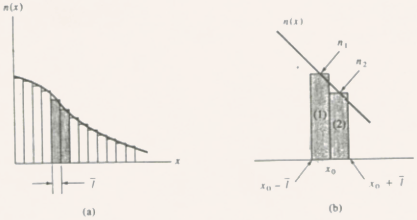
Fig.3.6 An arbitrary electron distribution along the x-direction: (a) each segment divided into lengths equal to the mean free path
 ,
and (b) expanded view of two segments centered at
,
and (b) expanded view of two segments centered at 
- Consider any arbitrary distribution n(x), with x divided into segments
 (mean
free path) wide, with n(x) evaluated at the center of each segment.
(mean
free path) wide, with n(x) evaluated at the center of each segment.
- In
 , half of the electrons
in segment (1) to the left of
would move into segment (2), and in the same time, half of the electrons
in segment (2) to the right of
would move into segment (1).
, half of the electrons
in segment (1) to the left of
would move into segment (2), and in the same time, half of the electrons
in segment (2) to the right of
would move into segment (1).
- Therefore, the net number of electrons moving from segment (1) to
segment (2) through within
a mean free time
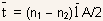 ,
where A is the area perpendicular to x.
,
where A is the area perpendicular to x.
- Thus, the electron flux density in the +x-direction
- Note: is a small differential length, thus,


where x is taken at the center of segment (1) and x =
- In the limit of small
 (i.e., small mean free path
between collisions)
(i.e., small mean free path
between collisions)

- The quantity
 is called the electron diffusion coefficient
- The minus sign in the expression for
 implies that the diffusion proceeds from higher electron concentration
to lower electron concentration.
implies that the diffusion proceeds from higher electron concentration
to lower electron concentration.
- Similarly, holes diffuse from a region of higher concentration to
a region of lower concentration with a diffusion coefficient

Thus,

and the diffusion current density

- Note: electrons and holes move together in a carrier gradient, however, the resulting currents are in opposite directions because of the opposite charges of the particles.
 Diffusion and Drift of Carriers: Built-in Fields
- The total current density can thus be written as


and the total current density is

- The total current may be due primarily to one of these two components,
depending upon the carrier concentrations, their gradients, and the
electric field.
- Thus, minority carriers can contribute to current conduction significantly
through diffusion, even though they contribute very little to the drift
term (due to their low concentrations).
- Since electrons drift opposite to the direction of the electric field
(due to their negative charge), their potential energy increases in
the direction of the electric field.
- The electrostatic potential varies in the opposite direction, and
can be given by V(x) = Ei(x)/(-q).
- Thus, the electric field can be given by

- Note: electrons drift downhill in a band diagram, therefore, the electric
field points uphill in a band diagram.
- Note: in equilibrium, no net current => any fluctuation in carrier
concentration which brings about a diffusion current also sets up an
electric field, which opposes the diffusive motion => thus, equilibrium
is established.
- This field is referred to as the built-in field, and can be caused
by doping gradients and/or variation in the band gap.
- Equating the hole current density equation to zero, we get

- Now, EF does not vary with x in equilibrium, and the variation of
Ei with x is given above, thus,

- This is an extremely important equation valid for both carrier types,
and is called the Einstein relation gives the relation between D and
, which is a function only of temperature, and allows calculation of
one if the other is known.
EXAMPLE 3.3
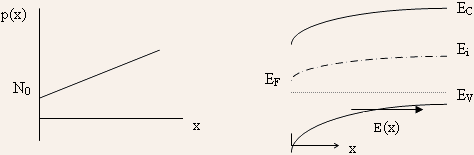
An intrinsic Si sample is doped with acceptors from one side such that

(a) Find an expression for E(x) at equilibrium from x = 0 to 5 m.
(b) Evaluate E(x) at x = 0 and 5 m.
(c) Sketch a band diagram and indicate the direction of E
SOLUTION
(a) Recall, at equilibrium, the hole current density
 Thus,
Thus,  where use has
been made of the Einstein relation and 100% ionization is assumed. Thus,
the electric field varies inversely with distance and has positive values
throughout.
where use has
been made of the Einstein relation and 100% ionization is assumed. Thus,
the electric field varies inversely with distance and has positive values
throughout. (b) E(0) = 52 V/cm and E(L) = 26 V/cm (c) Note: E(x) = (1/q)(dEi/dx). Since E(x) varies inversely with x, hence Ei (and consequently, both EC and EV) will have a logarithmic (ln) dependence on x.
 Diffusion and Recombination: The Continuity Equation
- In the description of conduction processes, the effects of recombination
must be included, since they can cause a variation in the carrier distribution.
- Hole conservation equation:

i.e., rate of hole buildup = increase of hole concentration in per
unit time recombination rate.
per
unit time recombination rate.
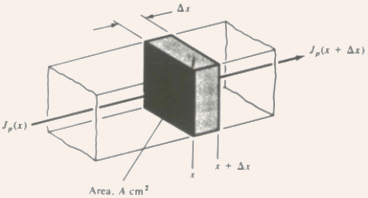
Fig.3.7 Setup to obtain particle count: current entering and leaving a volume.
- For
 ,
,

- This is called the continuity equation for holes, and, similarly,
for electrons, we can write

- When the current is carried entirely due to diffusion (negligible
drift), then we obtain the diffusion equation for electrons, given by

and, similarly for holes,

Steady State Carrier Injection: Diffusion Length
- In steady state, if a distribution of excess carriers is maintained,
then the diffusion equations become

where
are the electron diffusion length and the hole diffusion length, which is the average distance an electron or a hole diffuses before recombining respectively.
- Case study: suppose excess holes are injected into a semi-infinite
n-type bar, which maintains a constant concentration
 (relevant
problem in a forward biased diode).
(relevant
problem in a forward biased diode).
- Obviously, the excess holes would diffuse into the n-type bar, recombine
with the electrons with a characteristic lifetime
 (and diffusion length
  ),
and for large values of x, the excess hole concentration should decay
to zero; thus,
),
and for large values of x, the excess hole concentration should decay
to zero; thus,

and the decay profile is exponential.
- The steady state distribution of excess holes causes diffusion, and
therefore, a hole current in the direction of decreasing concentration,
given by

(This equation would come handy in the diode analysis.)
The Haynes-Shockley Experiment
- Counterpart of the Hall effect experiment.
- Independently determines the minority carrier mobility and diffusion
coefficient
.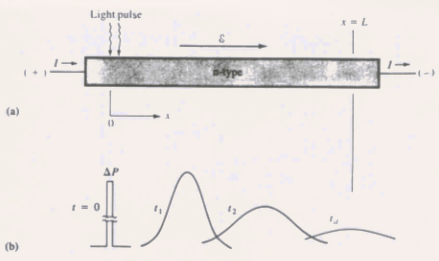
Fig.3.8 Schematic for Haynes-Shockley experiment: drift and diffusion of a hole pulse in an n-type bar:
(a) sample geometry,
(b) shape and position of the pulse for different times along the bar.
Basic principle
- a pulse of excess holes is created in an n-type bar (which has an
applied electric field),
- as time progresses, the holes spread out by diffusion and move due to the electric field, and their motion is monitored somewhere down the bar,