32.4 Electrically Erasable Programmable Read Only Memory (EEPROM)
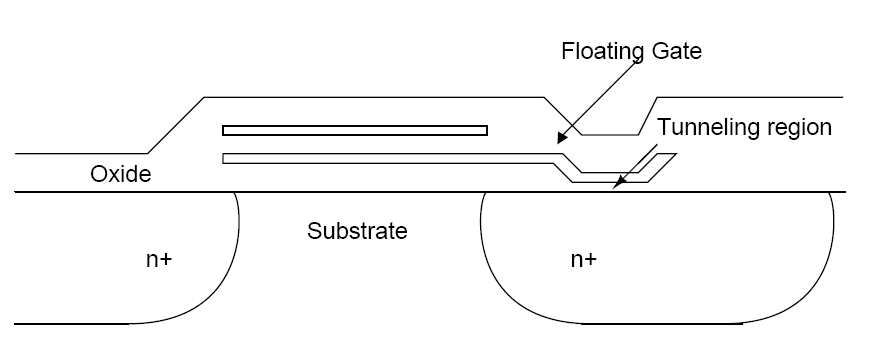
The major disadvantage of the EPROM approach is that erasure procedure has to occur "off system". This means the memory must be removed from the board and placed in the EPROM programmer for programming. The EEPROM approach avoids this labor intensive and annoying procedure by using another mechanism to inject or remove charges from the floating gate viz. tunneling. A modified floating gate device called the FLOTOX (Floating Gate Tunnel Oxide) transistor is used as a programmable device that supports an electrical erasure procedure. A cross section of the FLOTOX structure is shown in Figure 32.41.
Fig 32.41: FLOTOX Structure
It resembles the FAMOS device, except that a portion of the dielectric separating the floating gate from the channel and drain is reduced in thickness to about 10nm or less. When a voltage of approximately 10V is applied over the thin insulator, electrons can move to and from the floating gate through tunneling.
The main advantage of this programming approach is that it is reversible; that is, erasing is simply achieved by reversing the voltage applied during the writing process. Injecting electrons onto the floating gate raises the threshold, while the reverse operation lowers it. This bidirectionality, however, introduces a threshold control problem: removing too much charge from the floating gate results in a depletion device that cannot be turned off by the standard word-line signals. Notice that the resulting threshold voltage depends on initial charge on the gate, as well as the applied programming voltages. It is a strong function of the oxide thickness, which is subject to non-neglible variations over the die. To remedy this problem, an extra transistor connected in series with the floating gate transistor is added to the EEPROM cell. This transistor acts as the access device during the read operation, while the FLOTOX transistor performs the storage function. This is in contrast to the EPROM cell, where the FAMOS transistor acts as both the programming and access device.
The EEPROM cell with its two transistors is larger than its EPROM counterpart. This area penalty is further aggravated by the fact that the FLOTOX device is intrinsically larger than the FAMOS transistor due to the extra area of the tunneling oxide. Additionally, fabrication of very thin oxide is a challenging and costly manufacturing step. Thus EEPROM components pack less bits for more cost than EPROMs. On the positive side EEPROM offer high versatility. They also tend to last longer, as they can support upto 100,000 erase/write cycles. Repeated programmign causes a drift in the threshold voltage due to permanently trapped charges in the .This finally leads to malfunction or the inability to reprogram the device.

 .This finally leads to malfunction or the inability to reprogram the device.

