The mapping involved in systems
We shall next discuss the idea of mapping in a system in a little more depth.
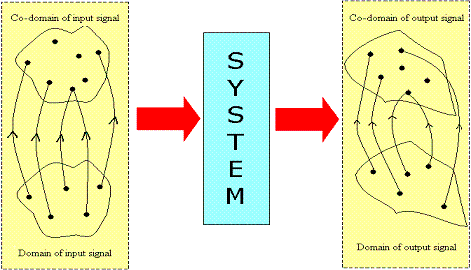
A signal maps an element in one set to an element in another. A system, on the other hand maps a whole signal in one set to a signal in another. That is why a system is called a mapping over mappings. Therefore, the value of the output signal at any instant of time (remember "time" is merely symbolic) in general depends
on the whole input signal. Thus, even if the independent variable for the input and output signal are the same (say time t), do not assume the value the output signal at, say t = 5 depends on only the value of the input signal at t = 5.
For example, consider the system with description:
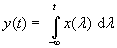
The output at, say t = 5 depends on the values of the input signal for all t <= 5.
Henceforth; we shall call systems with both input and output signal being continuous-time as continuous-time systems , and those with both input and output signal being discrete-time as discrete-time systems. Those that do not fall into either of these classes (i.e. input discrete-time and output continuous-time and vice-versa) we shall call hybrid systems.
Now that the necessary introductions are done, we can get on to system properties. 
|


