Examples of systems
Examples of systems are all around us. The speakers that go with your computer can be looked at as systems
whose input is voltage pulses from the CPU and output is music (audio signal). A spring may be looked as a system with
the input , say, the longitudinal force on it as a function of time, and output signal
being its elongation as a function of time. The independent variable for the input and output signal of a system need not even be the same.
In fact, it is even possible for the input signal to be continuous-time and the output signal to be discrete-time or vice-versa. For example, our speech is a continuous-time signal, while a digital recording of it is a discrete-time signal! The system that converts any one to the other is an example of this class of systems.
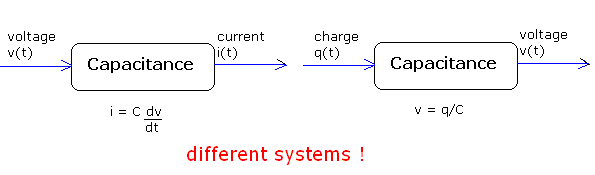
As these examples may have made evident, we look at many physical objects/devices as systems, by identifying some variation associated with them as the input signal and some other variation associated with them as the output signal (the relationship between these, that essentially defines the system depends on the laws or rules that govern the system) . Thus a capacitance with voltage (as a function of time) considered as the input signal and current considered as the output signal is not the same system as a capacitance with, say charge considered as the input signal and voltage considered as the output signal. Why?
The mappings that define the system are different in these two cases.
We shall next discuss what system description means.

|


