Lecture 11 : Differential and Difference Equations
Linear
Constant Coefficient Differential and Difference Equations
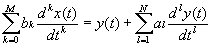
Equations
of the form shown below are called linear
constant coefficient differential equations:
The above description is in the
implicit form. Hence it does not yield a unique interpretation.
But we can make the system LSI by adding the following
conditions:
Interpret the equation as holding for all time.
If we are concerned with only limited interval of
time, then impose zero initial conditions.
Also note that the above system is causal.
This is clear from the
following argument:
Consider two inputs p(t)
and q(t)
such that for t<T,
p(t)=q(t). Let r(t)
and s(t)
be their respective outputs. Now let
x(t)=p(t)-q(t). Thus x(t)=0
for t<T.
From the initial conditions we get output of x(t)
as y(t)=0
for t<T.
But from linearity property we have y(t)=r(t)-s(t)=0
for t<T.
Thus r(t) = s(t)
for t<T
and the system is causal.
Example:
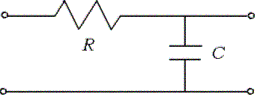
Consider the following RC system. If voltage across
C is 2V initially, show that the system is not LSI.
For
discrete variables, the corresponding equation is called the
linear constant coefficient
difference equation. Instead
of derivatives we have delays as shown below.