Lecture 11 : Differential and Difference Equations
Properties of
the Derivative Operator system:
1.
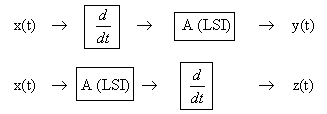
Cascade of systems Suppose
we give the output of the derivative operator system
as input to another LSI system 'A'. Let y(t) be the
output of the combined system for some given input x(t).
Now suppose we give x(t) as input to the system 'A'
first and then pass its output to the derivative operator
system. Let the final output now be z(t). Then from
the property that cascading of LSI systems is independent
of the order of cascading, we get y(t) = z(t).
2.
Memory of the System The
system obviously possesses memory as the derivative
operator requires a certain interval length to be defined
in.
3.
Causality of the System
To answer this we must consider the left, right and
center derivates separately. Clearly the left derivative
is causal while the center and right derivatives may
or may not be so. However for a differentiable function,
all the three derivatives being equal, the system is
indeed causal.
4.
Stability of the System Consider
the input signal shown below. Clearly we see that a
bounded input does not lead to a bounded output which
becomes obvious at points where the derivative of the
input signals tends to infinity. Thus the system is
not stable.
x(t)
Exercise:
Give an example of a bounded input signal such that
its derivative is not bounded as time tends to infinity?
5.
Invertibility of the System
Is the derivative operator invertible? No, because when
we consider the class of constants as input then the
output is always zero. Thus the derivative operator
is not one is to one. However the system is invertible
upto an additive constant.