|
Differential
and Difference Equations
We look at a
special class of LSI systems that are frequently encountered
in real life applications, namely those that are described
by differential and difference equations. We
first consider the derivative operator as a system:
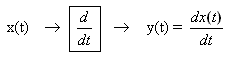
The
above system is an LSI system.
Proof:
The given system is obviously
linear due to the linearity of the derivative operator.
Also shift invariance
can be easily shown as below:
Let h(t) = t-t0 and g(t) = x(t-t0)
= x(h(t)). Let the output of the system to x(t) be y(t).
( y(t) = d x(t) / dt )
Now g'(t) = x'(h(t)).h'(t) =
x'(t-t0)
Thus input x(t-t0) gives an output y(t-t0).
Hence the system is LSI.
Note : Also it is
now clearly seen that if the input to an LSI system
is differentiated, then the output of that system is
also differentiated. This property may be proved
by taking the limit of the expression:
{x(t+h)-x(t)}/h as 'h' tends to zero and using the linearity and shift-invariance
of LSI systems.
|


