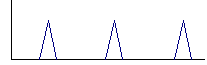
Let us look more closely into our analysis of sampling
using a rectangular train of pulses. This signal had a
Fourier series representation and multiplication of the
band-limited signal with it gave rise to a signal xs(t). The spectrum
of this signal had periodic repetitions of the original
spectrum modulated by the Fourier series coefficients of
the train of pulses. But this much would hold even if
the rectangular pulse train were replaced by any
periodic signal (whose Fourier series exists) with the
same period.
The Fourier series coefficients would
definitely change but we are interested only in the
central copy. As long as that is non-zero we can still
reconstruct the signal by passing it through an ideal
low-pass filter. The constant Fourier series co-efficient
is proportional to the average value of the periodic
signal. Thus, any periodic
signal, whose Fourier series exists, and has a non-zero
average, with fundamental frequency greater than twice
the bandwidth of the band-limited signal can be used
to sample it; and the original signal can be reconstructed
using an ideal low-pass filter.
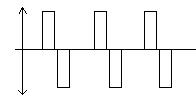
Of course, if the periodic signal
used has a zero average, like the one shown below, an
ideal low-pass filter cannot be used for reconstruction.
|