Module 3 : Sampling and Reconstruction
Lecture 24 : Realistic Sampling of Signals


Fourier series representation of p(t)

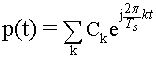
Now the Fourier Series Representation of 'p(t)' is given as:                                       
                          
                                                        
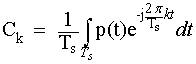
Where the Fourier Coefficients of the series are defined as:
                                                       
 
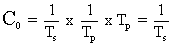
For  the constant term (k = 0) in the Fourier Series expansion is:
                                                       

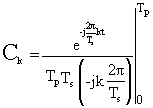
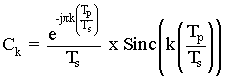
In general we can represent kth coefficient as:


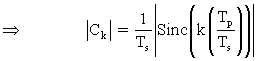
Simplifying the above term we get the envelope of the coefficients as a sinc function:


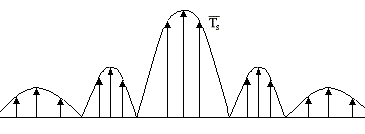
Lets have a look at the envelope of which is shown as below:


Looking at the expression for the coefficients of the Fourier Series Expansion we observe that:

  If is large then there are few samples in the main lobe.
  As increases then the main lobe broadens.
  As  coefficients become constant ( they tend to ) as the central lobe tends to infinity.                                                 
 

  As 'p(t)' tends to the train of impulses we had started our discussion on sampling with. Notice then that the observations above are consistent with this. The Fourier coefficients of the periodic train of impulses are indeed all constant and equal to the reciprocal of the period of the impulse train.


The Fourier Transform of the Sampled Signal .

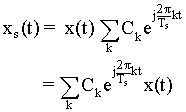
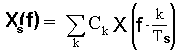
We now see what happens to the spectrum of continuous time signal on multiplication with the train of pulses. Having obtained the Fourier Series Expansion for  the train of periodic pulses the expression for the sampled signal can be written as:


Taking Fourier transform on both sides and using the property of the Fourier transform with respect to translations in the frequency domain we get:


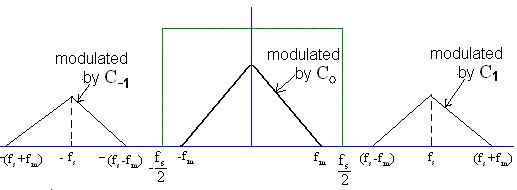
This is essentially the sum of displaced copies of the original spectrum modulated by the Fourier series coefficients of the pulse train. If 'x(t)' is Band-limited so long as the the displaced copies in the spectrum do not overlap. For this the condition that 'fs' is greater than twice the bandwidth of the signal must be satisfied. The  reconstruction is possible theoretically, using an Ideal low-pass filter as shown below:


Thus the condition for faithful reconstruction of the original continuous time signal is : where is the bandwidth of the original band-limited signal.