|
Realistic sampling of signals:
Our goal of
achieving a sampled signal is possible by the
multiplication of the original C.T. signal with the
generated train of pulses. Now these two signals
are multiplied practically with the help of a multiplier
as shown in the schematic below. In our analysis
so far, this is how we imagined sampling of a signal.
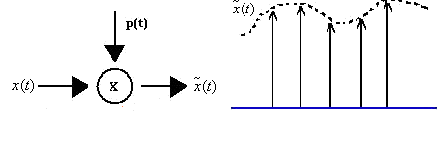
But
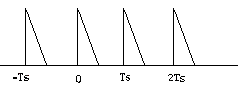
impulses are a mathematical concept and they cannot be
realized in a real system. In practice we can best
obtain a train of pulses called a saw-tooth pulse. These
pulses are generally used for creating a time-base for
the operation of many electronic devices like the CRO
(Cathode Ray Oscilloscope).
Practical Implementation:
Lets see how the train of pulses
of the following kind can be multiplied by a signal 'x(t)'.
Consider the circuit below.
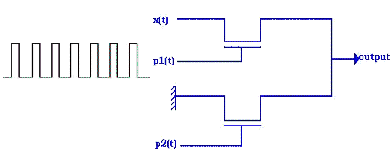
The two pulse trains p1(t) and
p2(t) are synchronized so that when one
is high the other is low and vice verse as shown in the
figure below:
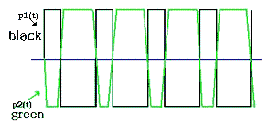
In the circuit when x(t) and p1(t)
are multiplied we get the output. Thus we get the output
when p1(t) is ON and it
is
zero when p2(t) is ON.
You have just seen how we can
multiply a signal x(t) with the following
periodic pulse train p(t) to obtain the
sampled signal  .
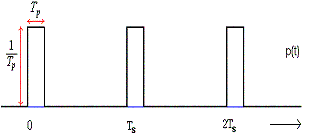
Now the train of pulses that we had used is shown below
with respect to its amplitude and period. .
Now the train of pulses that we had used is shown below
with respect to its amplitude and period.
|


