| Parseval's
Theorem
We now obtain the result equivalent
to the Parseval's theorem we have already seen in the
context of periodic signals.
Let x(t) and y(t) be periodic with
a common period T.

Applying the Convolution theorem equivalent
we have just proved on  we get:

Put t = 0, to get: 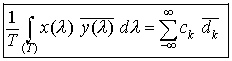
Compare this equation with the Parseval's
theorem we had proved earlier.
If we take x = y, then T becomes the
fundamental period of x and:
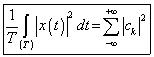
Note the left-hand side of the above
equation is the power of x(t).
Note also that the periodic convolution
of  yields
a periodic signal with Fourier coefficients that are the
modulus square of the coefficients of x(t). yields
a periodic signal with Fourier coefficients that are the
modulus square of the coefficients of x(t).
|


