|
Fourier Transform of  continued . continued .
Now,
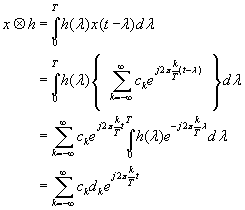
But then, we have seen that  can be non-zero only when k is a multiple of n, and
 can be non-zero only when k is a multiple of m. Their
product can clearly be non-zero only when k is a multiple
of m and n. Thus if p is the LCM (least common multiple)
of m and n, we have:
can be non-zero only when k is a multiple of m. Their
product can clearly be non-zero only when k is a multiple
of m and n. Thus if p is the LCM (least common multiple)
of m and n, we have:
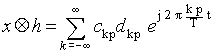
What can we make out of this?
The
Fourier Transform of the circular convolution has impulses
at all (common) frequencies where the Fourier transforms
of x(t) and h(t) have impulses.
The circular convolution therefore "picks out"
common frequencies, at which the spectra of x(t) and
h(t) are non-zero and the strength of the impulse at
that frequency is the product of the strengths of the
impulses at that frequency in the original two spectra.
This result is the equivalent of the
Convolution theorem in the context of periodic convolution.
|


