|
Periodic Convolution
We have applied the convolution theorem to convolutions
involving:
(i) two aperiodic signals
(ii) one aperiodic
and one periodic signal.
But, convolutions between periodic signals diverge,
and hence the convolution theorem cannot be applied
in this context. However a modified definition of convolution
for periodic signals whose periods are rationally related
is found useful. We look at this definition now. Later, we will prove a result similar to the Convolution theorem in the context of periodic signals.
Consider the following signals
x(t) periodic with period T1 and h(t) periodic
with period T2 where
T1 and T2 are rationally
related.
Let T1 / T2 = m / n (where
m and n are integers)
Hence, m T2 = n T1 = T is
a common period for both x(t) and h(t).
Periodic convolution or circular
convolution of x(.) with h(.) is
denoted by  and
is defined as : and
is defined as :
= 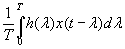
Note the definition holds even if T is not the smallest common period for x(t) and h(t) due to the division by T. Thus we don't need m and n to be the smallest possible integers satisfying T1 / T2 = m / n in the process of finding T.
Also, show for yourself that the periodic convolution
is commutative, i.e:  .
Also, notice that the convolution is periodic with period
T1 as well as T2.
More on this later. .
Also, notice that the convolution is periodic with period
T1 as well as T2.
More on this later.
|


