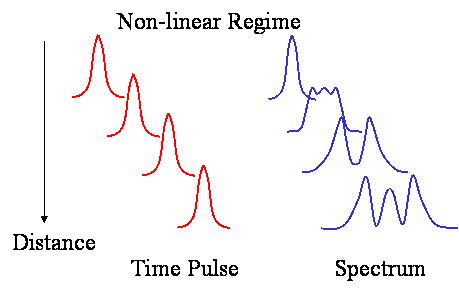
In the non-linear regime, the non-linearity length is smaller than the fiber length and the dispersion length is larger than the fiber length.
The NSE in this case is given as
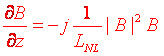 
The solution to this equation is

Where the non-linear phase

The phase of the optical carrier is dependent on the location on the pulse. The phase profile is same as the intensity profile of the pulse. The pulse is therefore phase modulated due to its own intensity profile. This phenomenon is called the Self-Phase Modulation (SPM). 
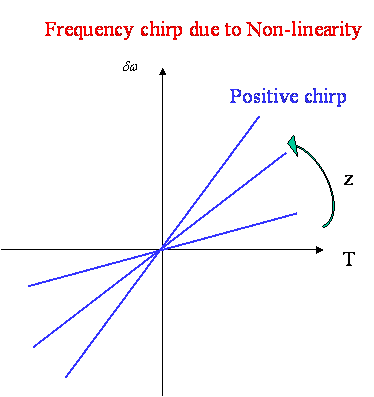
For this phase modulation, there is corresponding frequency modulation. The frequency deviation as a function of time T is

The frequency deviation is proportional to the rate of change of the pulse envelop. For positive T (trailing edge of the pulse), the slope of the envelop is negative, and therefore the frequency deviation is positive. For negative T (leading edge of the pulse) the frequency deviation is negative.
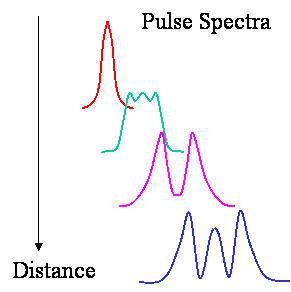
The spectrum of the pulse broadens with distance as the new frequencies are created.
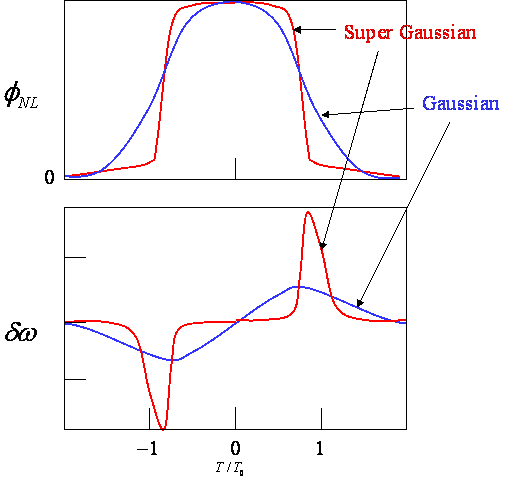
For a Gaussian and super-Gaussian pulses the frequency chirp is given in the Fig.
Where the super-Gaussian pulse is defined as

Super-Gaussian pulses with large  can be used to represent rectangular pulses. can be used to represent rectangular pulses.
As the figure shows, the frequency deviation is zero at the center of the pulse, it increases as we shift off center due to increase in the slope of the envelop reaches the maximum, and then decreases as we shift further due reduction of the power and hence the non-linearity.
Following important things can be noted about the SPM.
• Due to SMP the frequency chirp is always positive.
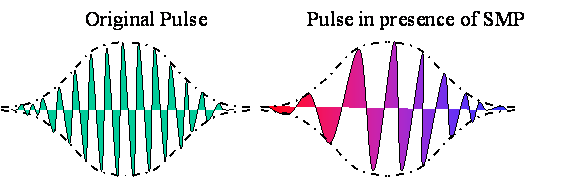
• The pulse shape in time domain remains unaltered. That is, as seen in the previous module, the spectrum broadens due to non-linearity, but the pulse shape in time domain remains unaffected. The pulse then looks as shown in Fig.
• With distance, the frequency chirp slope increases and the spectrum gets broadened.
The important thing to note is that if dispersion is anomalous and non-linearity is present, the frequency chirps created by two effects are opposite in nature. It is the possible that the two chirps cancel giving chirp-free pulse. In this case neither the pulse nor its spectrum broadens. The undistorted pulse is called the ‘ SOLITON'
|