In this regime the NSE has just the dispersion term.
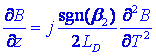
Let the input Gaussian pulse be given as

The NSE can be solved by taking Fourier transform, to give solution

We can write the expression in amplitude and phase form as

Where,
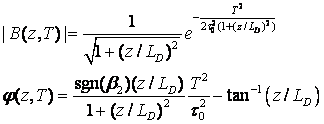
Two important things can be observed here.
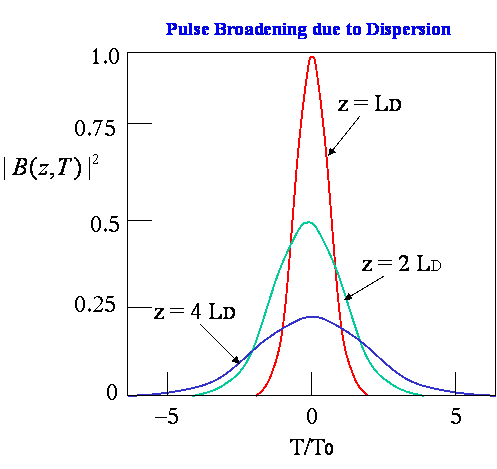
• The shape of the Gaussian pulse remains Gaussian as the pulse travels along the fiber in dispersive regime. However, the pulse width increases with distance. Over a distance z, the pulse width is  . It should also be noted that the pulse always broadens irrespective of the sign of . It should also be noted that the pulse always broadens irrespective of the sign of  . We can then see that the dispersion length is that distance over which the pulse width increases to . We can then see that the dispersion length is that distance over which the pulse width increases to  times of its original value. times of its original value.
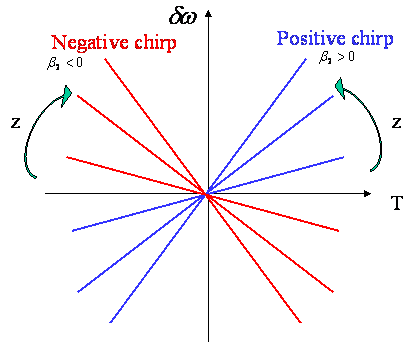
• Internally the pulse gets phase modulated since the phase of the pulse is a function of T. Since the rate of change of phase is the frequency, we get change in pulse carrier frequency as

The frequency varies linearly as a function of time, T. It is then said that the pulse is linearly chirped. For positive  , the frequency is higher on the trailing edge of the pulse and is lower at the leading edge of the pulse as shown in Fig. The reverse happens when , the frequency is higher on the trailing edge of the pulse and is lower at the leading edge of the pulse as shown in Fig. The reverse happens when  is negative. If is negative. If  is negative the dispersion is called anomalous. is negative the dispersion is called anomalous.
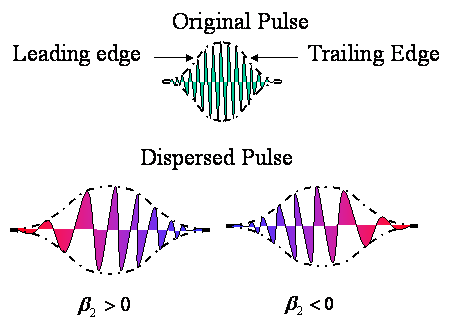
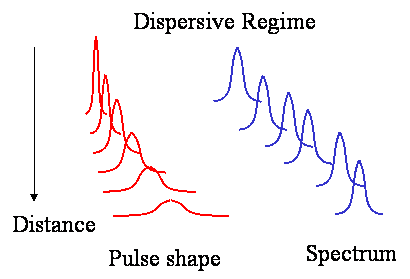
In Dispersive regime the pulse broadens but its spectrum remains same. Only different frequencies get separated in time due to dispersion, but there are now new frequencies generated as shown in Fig.
|


