The pulse evolution on an optical fiber in general is governed by the Non-linear Schrodinger equation (NSE) .

The different terms in the equation describe different effects like the group velocity, group velocity dispersion (GVD), fiber loss, and fiber non-linearity.
Since we are interested here in the pulse evolution, the delay in pulse arrival is of less consequence. We therefore define a moving time frame which moves with the group velocity along the fiber. In this frame, the time is given as

Where  is the group velocity of the pulse. is the group velocity of the pulse.
The NSE in the moving time frame naturally would not have the second term since the pulse appears stationary in the moving frame. The NSE therefore becomes

Let us now assume that the input pulse to the fiber is Gaussian in shape with width  and power P. and power P.
Let us define two important characteristic lengths related to the dispersion and non-linearity as
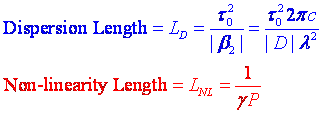
The two lengths essentially tell us the distance a pulse has to travel on the fiber to show the respective effect.
We can also define the effective length the pulse travels on the fiber (in presence of loss)

The is the length which the pulse travels before is power is unacceptably small.
In the following discussion, let us assume the fiber to be loss-less, i.e.  . .
The NSE then becomes

Where  is the normalized pulse. is the normalized pulse.  . .
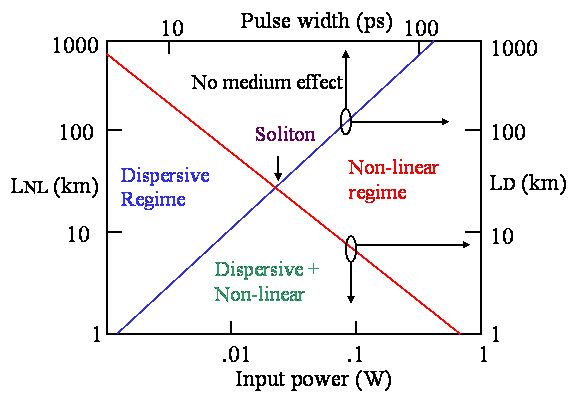
We can now define different regimes of pulse propagation depending upon the length of the fiber, L.
1.  : In this case neither the dispersion nor the non-linearity plays a role in pulse propagation and the fiber is merely a medium of energy transport. : In this case neither the dispersion nor the non-linearity plays a role in pulse propagation and the fiber is merely a medium of energy transport.
2.  : This is Dispersive regime . The broadens as it propagates on the fiber. Since dispersion length is proportional to the square of the pulse width, for narrower pulses, the dispersion length is smaller and therefore the dispersive effect are significant. : This is Dispersive regime . The broadens as it propagates on the fiber. Since dispersion length is proportional to the square of the pulse width, for narrower pulses, the dispersion length is smaller and therefore the dispersive effect are significant.
3.  : This Non-linear regime . In this case we get a phenomenon called the self-phase modulation. The pulse spectrum expands but the pulse in time domain remains unchanged. Since the non-linearity length is inversely proportional to the pulse power, for high power but for not so narrow pulses this condition prevails. : This Non-linear regime . In this case we get a phenomenon called the self-phase modulation. The pulse spectrum expands but the pulse in time domain remains unchanged. Since the non-linearity length is inversely proportional to the pulse power, for high power but for not so narrow pulses this condition prevails.
4.  : In this situation both, the dispersion and non-linearity play a role in pulse propagation, and there is possibility of canceling the two effects giving what is called the Soliton . : In this situation both, the dispersion and non-linearity play a role in pulse propagation, and there is possibility of canceling the two effects giving what is called the Soliton .
The four regimes are shown in Fig.
The Fig. shows the variation of dispersion and non-linearity lengths as a function of pulse width and pulse power for  . . |