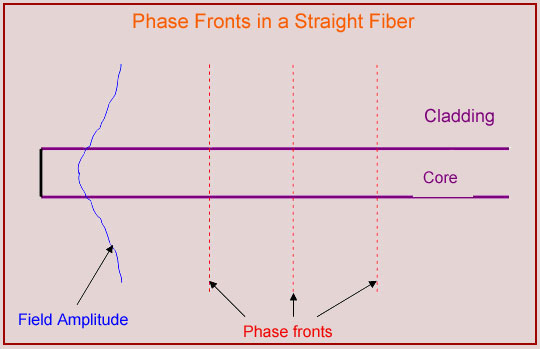
As we have seen, the light inside a fiber propagates in the form of modes. The modal fields decay inside the cladding away from the core cladding interface. Theoretically the field in the cladding is finite no matter how far away we are from the core-cladding interface. Now look at the amplitude and phase distribution for the fibers which are straight and which are bent over an circular arc as shown in Fig. |


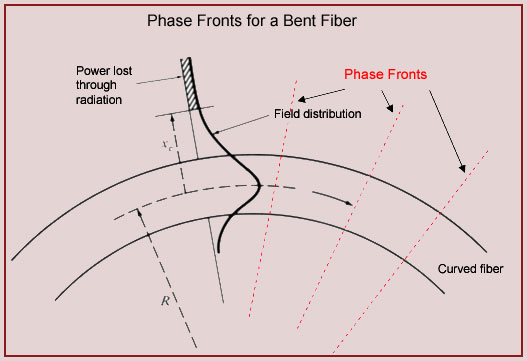
 from the fiber where the velocity tries to become greater than the velocity of light in the cladding medium.
  gets detached from the mode and radiates away. This is called the bending or the radiation loss.
  .
.  reduces, the radiation loss increases. The
  reduces as the radius of curvature of the bent fiber reduces, that is the fiber is sharply bent.
  that is for a given fiber bent, if the field spreads more in cladding, the bend loss increases. We know from the modal field analysis that the lower order modes are more confined to the core, that is their fields decay rapidly in the cladding, and the higher order modes have more slowly decaying energy in the cladding . The higher order modes hence are more susceptible to the radiation loss compared to the lower order modes.
