| Attenuation on Optical Fiber |
 |
 |
The signal on optical attenuates due to following mechanisms : |
| (1) |
Intrinsic loss in the fiber material. |
| (2) |
Scattering due to micro irregularities inside the fiber. |
| (3) |
Micro-bending losses due to micro-deformation of the fiber. |
| (4) |
Bending or radiation losses on the fiber. |
| |
The first two losses are intrinsically present in any fiber and the last two depend on the environment in which the fiber is laid. |
| |
|
| |
MATERIAL LOSS |
| |
|
| (a) |
Due to impurities: The material loss is due to the impurities present in glass used for making fibers. Inspite of best purification efforts, there are always impurities like Fe, Ni, Co, Al which are present in the fiber material. The Fig. shows attenuation due to various molecules inside glass as a function of wavelength. It can be noted from the figure that the material loss due to impurities reduces substantially beyond about 1200nm wavelength. |
| |
|
| (b) |
Due to OH molecule: In addition, the OH molecule diffuses in the material and causes absorption of light. The OH molecule has main absorption peak somewhere in the deep infra-red wavelength region. However, it shows substantial loss in the range of 1000 to 2000nm. |
| |
|
| (c) |
Due to infra-red absorption : Glass intrinsically is a good infra-red absorber. As we increase the wavelength the infra-red loss increases rapidly. |
| |
|
| |
SCATTERING LOSS |
| |
|
|
The scattering loss is due to the non-uniformity of the refractive index inside the core of the fiber. The refractive index of an optical fiber has fluctuation of the order of  over spatial scales much smaller than the optical wavelength. These fluctuations act as scattering centres for the light passing through the fiber. The process is, Rayleigh Scattering . A very tiny fraction of light gets scattered and therefore contributes to the loss. over spatial scales much smaller than the optical wavelength. These fluctuations act as scattering centres for the light passing through the fiber. The process is, Rayleigh Scattering . A very tiny fraction of light gets scattered and therefore contributes to the loss. |
| |
|
|
The Rayleigh scattering is a very strong function of the wavelength. The scattering loss varies as  . This loss therefore rapidly reduces as the wavelength increases. For each doubling of the wavelength, the scattering loss reduces by a factor of 16. It is then clear that the scattering loss at 1550nm is about factor of 16 lower than that at 800nm. . This loss therefore rapidly reduces as the wavelength increases. For each doubling of the wavelength, the scattering loss reduces by a factor of 16. It is then clear that the scattering loss at 1550nm is about factor of 16 lower than that at 800nm. |
| |
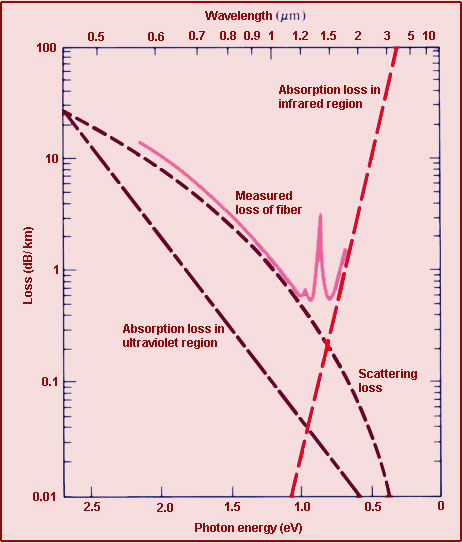
The following Fig. shows the infrared, scattering and the total loss as a function of wavelength. |
| |
|
 |
| |
|
|
It is interesting to see that in the presence of various losses, there is a natural window in the optical spectrum where the loss is as low as 0.2-0.3dB/Km. This window is from 1200nm to 1600nm. |
| |
|
|
There is a local attenuation peak around 1400nm which is due to OH absorption. The low-loss window therefore is divided into sub-windows, one around 1300nm and other around 1550nm. In fact these are the windows which are the II and III generation windows of optical communication. |
| |


