Module 4 : Signal Distortion on Optical Fibers - Attenuation
Lecture   : Signal Distortion on Optical Fibers - Attenuation
  

For an optical communication link the highest data rate is about 10GHz. This translates approximately to a wavelength range of 0.1nm. For all practical purposes, the loss of the optical fiber can be assumed constant over a bandwidth of 0.1nm. Therefore, we note that uniform amplitude response condition is well satisfied for the optical fiber. The signal depending upon the loss may reduce in amplitude but there is no distortion of the signal due the loss.

   
The typical optical wavelength is about 1550nm and the signal bandwidth is about 0.1nm. That means the optical system is a very narrow band system, the fractional bandwidth is << 1. One would then wonder whether over such a narrow bandwidth the linearity of the phase response be violated! Or would the velocity differ significantly over such a narrow bandwidth to give substantial distortion! The answer to this would be ‘NO'. However before we conclude this let us look at the special nature of the optical signals.
   
   
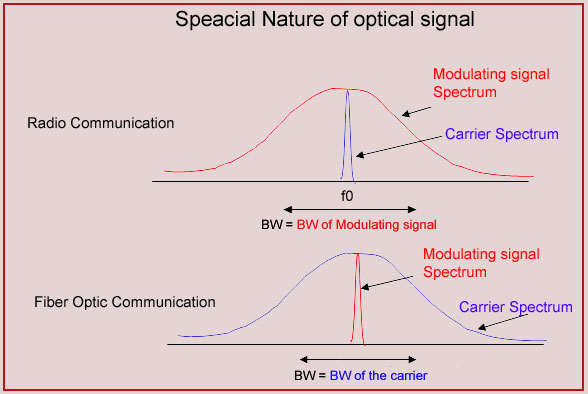
Look at the Figure. The Figure gives the spectra of modulating signal and the carrier for two types of communication, radio communication and the optical communication. There is marked difference between the two cases which can be summarized as follows:
   
(1) For radio communication the intrinsic spectral width of the carrier is very small compared to the spectral width of the modulating signal. Therefore the bandwidth of the modulated signal is almost equal to the BW of the modulating signal. (twice if the signal is simple AM). Also the shape of the spectrum of the modulated signal is almost same as that of the modulating signal. So in radio communication, the spectrum of the modulating signal is preserved, except that it is shifted by the carrier frequency.
   
(2) For optical communication the scenario is quite opposite. A typical optical source like LED has an intrinsic spectral width of 30-60nm (approximately 4000 to 8000GHz), and a source like a laser diode has a spectral width of 2-3nm (approximately 250 to 400 GHz). That means for optical communication the spectral width of the carrier is much greater than the spectral width of the data. The bandwidth of the modulated signal then is almost equal to the bandwidth of the carrier with hardly any signature of the data. So, in optical communication the spectrum cannot be used to recover the data. The demodulation therefore has to be done only in time domain. This is possible only by AM scheme where the signal can be recovered by a primitive technique of envelop detection.
   
The optical communication system hence cannot be treated on line similar to that used for normal radio communication link. Also since the modulated signal has a spectral width of few nm, the fractional bandwidth is not as small as it appeared earlier.
   
The optical communication system can be looked as a parallel multiple channel transmission of carriers spreading over the bandwidth of the carrier. One can then say that the distortion of the signal in optical communication is due to differential delay of the signal riding over different carriers within the spectral width of the carrier.
   
The signal pulse then goes on spreading as it travels along the optical fiber. The pulse broadening is proportional to the distance and it is also proportional to the spectral width of the carrier. This phenomenon is the dispersion .
   
So we conclude that when a signal pulse travels on an optical fiber it goes on broadening due to dispersion and goes on reducing in amplitude due to attenuation as shown in Fig. After certain distance the pulse shape is completely distorted not to resemble with the original pulse shape.