Module 17 : Integrated Optics II
Lecture : Integrated Optics II
                                                                      Active Devices

As mentioned above, the coupling coefficient is a function of the refractive index of the channel waveguide as well as the refractive index of the substrate.


If therefore fabricate a directional coupler on an active substrate like Lithium Niobate, the refractive index of the waveguide and consequently the coupling coefficient of the directional coupler can be changed dynamically by application of the electric field to the waveguide.


Because of the dynamic control of the coupling coefficient we can develop a variety of new devices as given in the following.


Amplitude Modulator

For a directional coupler, if the length is equal to the coupling length, the power in completely transferred to waveguide B. And if the length is equal to twice the coupling length, the power returns back to waveguide A.


So design a directional coupler on an active substrate such that when the electric field is not applied, , and when the electric field is applied, .


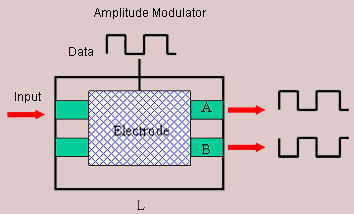
Take the output only from one of the waveguides. The output will vary in accordance with the applied field and we will get amplitude modulation.


A schematic of the amplitude modulator is shown in Fig.


Optical Switch

By using the same lay out as used for the amplitude modulator, we can realize an optical switch. Instead of data if apply the control voltage to the electrode, the output at any port can be switched ON or OFF. Of course the two outputs are complement of each other, so when one port is OFF the other will be ON and vice versa.


Optical Multiplexer

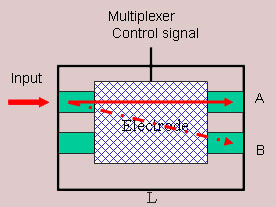
The same amplitude modulator structure can be used as an 1:2 multiplexer. By applying the control voltage to the electrode, the input signal can be connected to port A or port B as shown in Fig.