Module 17 : Integrated Optics II
Lecture : Integrated Optics II
                                                               Directional Coupler

Directional coupler is one of the very important devices which can be used for various applications like, optical amplitude modulator, power tapping, power divider, wavelength filter, optical switch, optical multiplexer, optical cross-connect and so on.


Here we first develop the basic understanding of the directional coupler and then we will study its implementation in an integrated form.


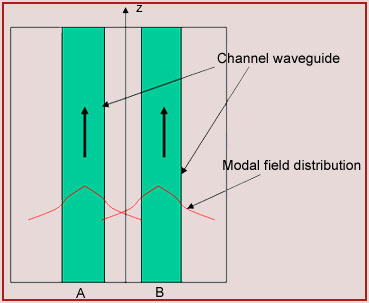
The directional coupler consists of two channel optical waveguides placed close to each other so that their fields can interact with each other as shown in Fig.


Let us say we excite only on of the waveguides (say A). The modal field of the waveguide A will be intercepted by waveguide B. Since there has to be continuity of the fields at the boundary of the waveguide B, some fields will get induced inside waveguide. However, being a bound structure, any arbitrary field can not get induced inside waveguide B, it has to be modal field. The modal field will have distribution similar to that of the modal field of waveguide A. The induced filed of waveguide will interact back with waveguide A.


So on the whole the fields of the two waveguides will start interacting. Moreover, the modal field of the waveguide will be propagating and therefore would need power. But the power has been supplied to waveguide A only, since we excited only waveguide A. In other words, waveguide B will tap power from waveguide A.

   
The important thing to note is there is exchange of power between two waveguides due to overlapping of the field outside the waveguide. This is called evanescent mode coupling.
   

With this qualitative understanding now we can analytically investigate the power exchange between two channel waveguides.


Let us say that the modal propagation constants for the two waveguide are respectively. Then in absence of mutual interaction the complex fields on the waveguide will be given as


Where, are amplitudes of the modal fields on the two wave guides. The two fileds satisfy the differential equations,

  And

Now in the presence of the other waveguide the fields are coupled. The governing equations therefore become

  And
 

Where, is the coupling coefficient between the two waveguides.