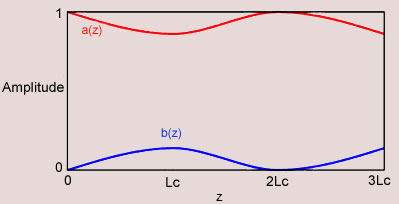
If the two waveguides are dissimilar i.e. if  , and if , and if  , field amplitude of waveguide A remains almost constant and amplitude of the wave on waveguide B is much less than 1. That is in this situation most of the power remains with waveguide A and a small power is transferred to waveguide B (see Fig). , field amplitude of waveguide A remains almost constant and amplitude of the wave on waveguide B is much less than 1. That is in this situation most of the power remains with waveguide A and a small power is transferred to waveguide B (see Fig). |

 .
. 
 , we get
 and the fields on the two waveguide become,


 , i.e. when
  ,
,  . That means the entire power gets transferred from waveguide A to waveguide B.
  , the entire power goes back to waveguide A.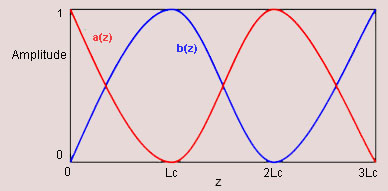
 . The coupling length is related to the coupling coefficient,
  as
as 

