(ii) D'Yakonov Perel mechanism:
If any given solids lack inversion symmetry because of its crystalline structure or because of an externally applied electric field, then an electron in the solid will experience strong spin-orbit interaction. As discussed in spin-orbit interaction section, Dresselhaus and Rasbha spin orbit interactions lift the degeneracy between the up spin and down spin states and any non-zero wavevector, so that these two states have different energies at the same wavevector state. In this respect, both the interactions truly behave like effective magnetic field, since a magnetic field also lifts the degeneracy between up spin and down spin states at any given wavevector. This effective magnetic field  will be dependent on the electron's velocity,
 , if it is spin independent.
Now, let us consider an ensemble of electrons drifting and diffusing in a solid. If every electron's velocity is the same and does not change with time, then the field is the same for all electrons and every electron precesses about this constant field with a fixed frequency. This does not cause any spin relaxation at all, i.e., if all electrons started with the same spin polarization, then after any arbitrary time they all have precessed by exactly the same angle and therefore they all have again the same spin polarization. The direction of this spin polarization may be different from the initial one, but that does not matter as the magnitude of the ensemble averaged spin does not change with time. Hence, there is no spin relaxation.
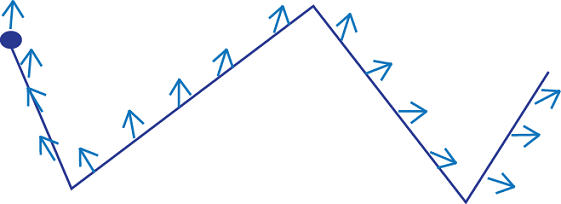
Figure 7.2: Schematic representation of D'yakonov–Perel mechanism. In noncentosymmetric crystals spin bands are no longer degenerate: in the same momentum state spin up has different energy than spin down. This is equivalent to having internal magnetic field, one for each momentum. The spin of an electron precesses along such a field until the electron momentum changes by impurity, boundary or phonon scattering. Then the precession starts again, but along a different axis. Since the spin polarization changes during the precession, the scattering acts against the spin relaxation [1].
On the other hand, if changes randomly with time because of scattering, then different electrons would have precessed by different angle after a given time because they have different scattering histories. Thus, even if all the electrons were injected with the same spin polarization, their spin polarizations gradually go out of phase with each other after a given time and the magnitude of the ensemble averaged spin will decay to zero (see Figure 7.2).