(i) Elliott-Yafet Mechanism;
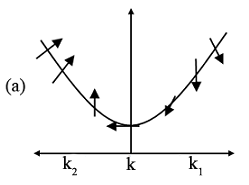
The Elliott-Yafet mechanism is based on the fact that in real crystals Bloch states (the wavefunction of a particle, usually, an electron, placed in a periodic potential) are not spin Eigen states. As a result, an electron's spin in the crystal does not really have one of two fixed polarizations: up or down. However, the actual spin polarization depends slightly on what the electron's wavevector is, which is schematically depicted in Figure 7.1.
 |
|
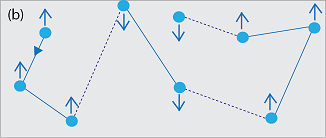
Figure 7.1: (a) Energy dispersion relation showing the spin polarizations at different wavevector states. Each wavevector has two possible mutually anti-parallel spin polarizations. A momentum changing collision event, that changes the wavevector state from k1 to k2, also changes the spin orientation since the Eigenspin polarizations at k1 and k2 are generally not parallel, (b) The periodic spin-orbit interaction makes the spin up Bloch states contain small spin-down amplitude, and vice-versa [1].
Each wavevector state still has two possible spin orientations that are mutually anti-parallel but spin orientations associated with different wavevector states can have arbitrary angle between them. If a collision event with a non-magnetic scatterer changes the momentum or wavevector of an electron, then it will change the spin as well since the spin orientations associated with the initial and final wavevector states are never mutually parallel. The spin state of a nearly up-spin electron at a wavevector state k1 and that of a nearly down-spin electron at a different wavevector state k2 are not strictly orthogonal, since they are not strictly anti-parallel. Thus, any collision with a non-magnetic scatterer that changes the wavevector of an electron from an initial state k1 to a state k2 can also couple the nearly down spin state at k1 to the nearly up spin state at k2. This coupling can flip the electrons spin from nearly up to nearly down. Such spin relaxation is always accompanied by some degree of momentum relaxation since the wavevector must change in order to change the spin.
The Elliott-Yafet mechanism is the primary spin relaxation mechanism often observed in low mobility materials (For example, organics), where the momentum relaxed scattering events are frequent.