A narrow beam of neutral atoms coming from an oven, after passing through collimating slits, is allowed to pass through a non-uniform magnetic field directed along the z-axis and finally fall on a collecting plate. The non-uniform magnetic field is produced by specially designed pole pieces of an electromagnetc as shown in Figure 2.1(b). The upper pole piece is in the form of a knife edge and the lower one has a channel cut in it parallel to the knife edge. This provides a field gradient in the z-direction. When no magnetic field is applied, the beam produces a single trace on the collecting plate as shown in Figure 2.2(a). On the other hand, the trace splits distinctly into more than one trace after switching on the field. In order to understand the observed behavior, we shall first focus on the theory of the experiment.
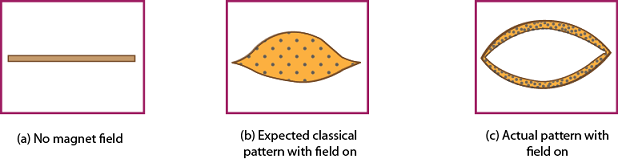
Figure 2.2: Distribution of silver atoms observed on a screen.
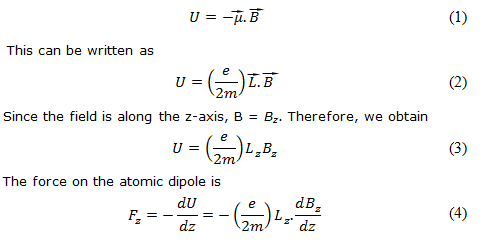
Now, each atom consists of orbital angular momenta and hence magnetic moments. If μ is the resultant magnetic moment of the atom, and B is the applied magnetic field then the potential energy of the atom in the field is
If space quantization of angular momentum does not exist, the L vectors for different atoms could be pointing in different directions in an arbitrary manner.