The early history of spin and Quantum Mechanics of spin:
Objectives:
The subject of spintronics deals mainly with the science and technology of using the spin degree of freedom of a charge carrier for various applications such as storing, encoding, accessing, processing and to transmitting information in some manner. However, such role had been traditionally delegated to the charge of the electron rather than the spin of the electron. Interest in spintronics is encouraged by replacing the charge with spin. Therefore, it is important to understand the history and quantum mechanics of spin. In the next two lectures, we shall discuss
1. the early history of spin,
2. the understanding of spin from quantum mechanical point of view, and
3. to obtain the eigenvectors of Pauli matrices to deduce the electron's spin orientations.
Early history of spin:
In 1925, an American scientist Ralph De Laer Kronig based on the anomalous Zeeman Effect postulated that in addition to the orbital angular momentum, an electron has an additional angular momentum caused by spinning about its own axis and the angular momentum associated with this self-rotation has a fixed magnitude of (1/2)ħ. However, the spin of an electron was already accidently measured in the famous Stern-Gerlach experiment, which is the turning point event in the history of spin. Otto Stern and Walther Gerlach in Frankfurt, Germany designed an experimental set up as shown in Figure 2.1 to verify the concepts of spin.
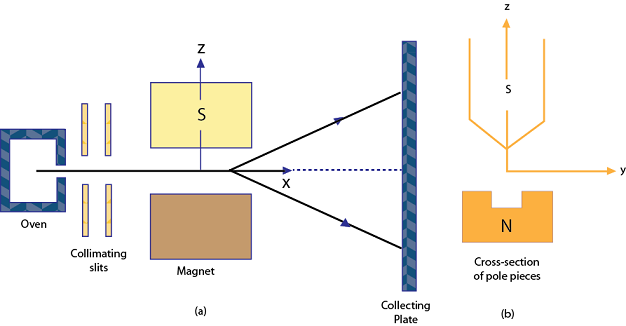
Figure 2.1: Schematic arrangement of Stern-Gerlach experimental set up [1].